
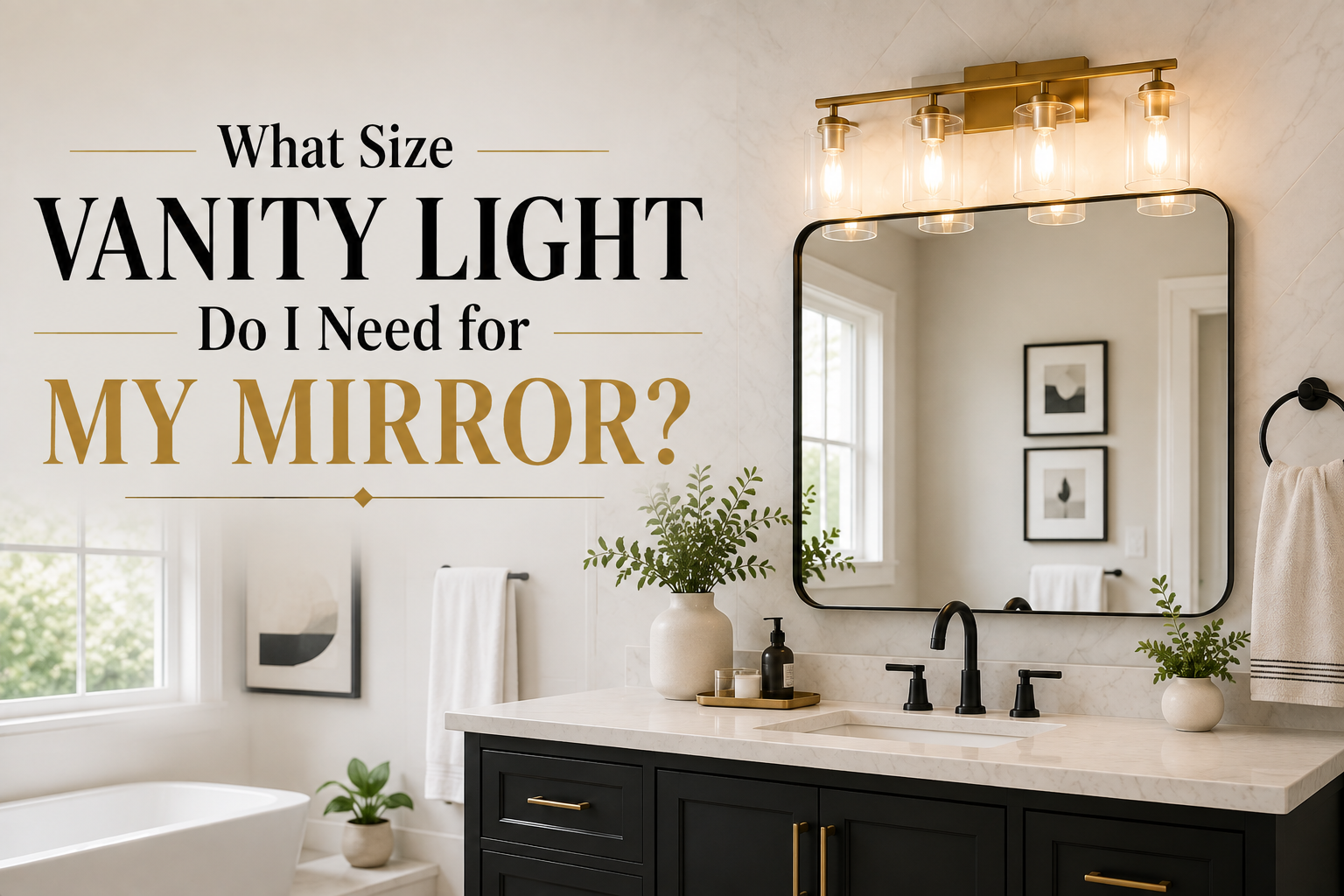

What Size Vanity Light Do I Need for My Mirror?
Choosing a bathroom vanity light is not only about finding a fixture that matches your faucets, cabinet hardware, or mirror frame.
Size matters just as much.
A vanity light that is too small can look lost above the mirror and may not distribute light evenly across the vanity. A fixture that is too large can overpower the mirror and make the wall feel crowded.
So, what size vanity light do you actually need for your mirror?
A practical starting point is to choose a vanity light that is approximately 75% of the width of the mirror. The fixture should generally remain narrower than the mirror rather than extending beyond its sides. Lighting manufacturers also recommend considering the overall size of the room when selecting the fixture.
This guide explains how to measure your mirror, choose the right fixture width, determine how many lights you need, and position your vanity lighting correctly.
Quick Vanity Light Size Guide

Here is a simple starting point when choosing an above-mirror vanity light:
| Mirror Width | Approximate Vanity Light Width |
|---|---|
| 24 inches | 18 inches |
| 30 inches | 22-24 inches |
| 36 inches | 27 inches |
| 42 inches | 30-32 inches |
| 48 inches | 35-36 inches |
| 60 inches | 42-45 inches |
| 72 inches | Consider two fixtures |
These measurements are guidelines rather than strict rules.
Fixture shape, number of bulbs, mirror style, ceiling height, and the overall scale of the vanity can all affect what looks best.
How Wide Should a Vanity Light Be Compared With the Mirror?

For a horizontal vanity light installed above a bathroom mirror, aim for a fixture that is roughly three-quarters of the mirror's width.
For example:
36-inch mirror x 0.75 = 27-inch vanity light
That gives the fixture enough presence to look proportional while leaving visible space on both sides.
Lumens recommends a bath bar approximately 75% as wide as the mirror, while Kichler advises that an above-mirror vanity fixture generally should not exceed the width of the mirror.
You do not need to match the measurement perfectly.
A 25-inch or 28-inch fixture could still look balanced over a 36-inch mirror depending on its design.
Should the Vanity Light Be Wider Than the Mirror?

Usually, no.
Keeping the vanity light narrower than the mirror creates a cleaner and more proportional appearance. Kichler specifically recommends that the full width of an above-mirror vanity fixture not exceed the mirror width.
For example, if your mirror measures 30 inches wide, installing a 40-inch vanity light above it could make the fixture visually dominate the mirror.
Instead, look for something closer to the 20- to 24-inch range.
There are exceptions, particularly with unusually narrow mirrors or intentional designer layouts, but staying within the mirror width is the safer starting point for most bathrooms.
What Size Vanity Light for a 24-Inch Mirror?

For a 24-inch mirror, look for a vanity light approximately 18 to 20 inches wide.
Compact two-light or small three-light fixtures usually work particularly well at this scale.
The Vivio Soffi LED Rectangle Vanity, for example, measures 19 inches wide, making it appropriately scaled for many smaller bathroom mirrors. It uses a 15W integrated LED source at 4000K and is damp-location listed.
For a more traditional approach, the Vivio Milla 2-Light Vanity measures 17.25 inches wide. Its clear glass shades and pipe-style frame work well in modern or industrial bathrooms, and the fixture can be mounted with shades facing up or down. The Milla 2-Light is also available in matte black and is damp-location listed.
Smaller fixtures are especially useful in:
- Powder rooms
- Guest bathrooms
- Small single-sink vanities
- Narrow bathroom layouts
Avoid forcing a large four-light vanity fixture into a compact space simply because you want additional brightness. Light output and fixture width are separate considerations.
What Size Vanity Light for a 30-Inch Mirror?

For a 30-inch mirror, approximately 22 to 24 inches is a good starting point.
This usually provides enough visual width without nearly matching the entire mirror.
A three-light fixture often works well here.
The Vivio Roxton 3-Light Vanity, for example, measures 21.75 inches wide and features three E26 light sources in a matte black finish with wood-style accents. It is damp-location listed, and its farmhouse-meets-modern profile gives it proportions that can work well with mirrors around this size.
The Vivio Kira 3-Light Vanity offers a slightly wider option at 22.5 inches, with clear cylinder glass shades and a matte black frame accented with gold detailing. The Kira brings more of an industrial character to the same general size range.
The Vivio Gia 3-Light Vanity is wider still at 24 inches, with a classic barn-light shade and gooseneck design. The Gia is available in glossy black, glossy white, and glossy red, and is damp-location listed.
What Size Vanity Light for a 36-Inch Mirror?

A 36-inch bathroom mirror pairs naturally with a vanity light around 27 inches wide.
This is one of the easiest combinations to size because three-light fixtures frequently fall within this range.
The Vivio Aura 3-Light Vanity, for example, is exactly 27 inches wide. Its proportions put it at approximately 75% of a 36-inch mirror's width. The Aura uses three E12 candle-base bulbs and features a two-toned matte black finish with candlelight bases available in brushed nickel, champagne gold, or matte black.
The Vivio Milla 3-Light Vanity is another option at approximately 26 inches wide, with clear glass shades and an industrial pipe-style design. It is also available in brushed nickel, and both finishes are damp-location rated.
A slightly smaller fixture can also work if it has substantial glass shades or a visually heavier design.
Remember that the physical width is not the only thing your eye notices.
Shade diameter, fixture height, projection from the wall, and number of lights can all influence how large a vanity light feels.
What Size Vanity Light for a 42-Inch Mirror?

For a 42-inch mirror, start around 30 to 32 inches wide.
A four-light fixture frequently works well at this scale because the additional light sources help distribute illumination across the wider mirror.
The Vivio Roxton 4-Light Vanity measures 30.75 inches wide, putting it close to the three-quarter-width guideline for a 42-inch mirror. Its matte black and wood-accent finish makes it a strong match for farmhouse, transitional, or rustic bathroom designs.
The Vivio Gia 4-Light Vanity is a wider alternative at 33 inches, using the same barn-light shade and gooseneck design as its 3-light sibling. It is available in the same glossy black, white, and red finishes and is damp-location listed.
Fixtures around this size provide enough visual presence without completely filling the space above the mirror.
What Size Vanity Light for a 48-Inch Mirror?

For a 48-inch mirror, approximately 35 to 36 inches is a strong starting point.
The Vivio Milla 4-Light Vanity measures 35.5 inches wide, which is almost exactly three-quarters of a 48-inch mirror. Its four E26 sockets, clear glass shades, and clean pipe-style frame give it an industrial character that suits modern, transitional, and minimalist bathrooms. The Milla 4-Light is also available in matte black and is damp-location rated.
The Vivio Aura 4-Light Vanity is another larger option at 37 inches wide, with a two-toned matte black and champagne gold finish. It is also available in matte black with brushed nickel.
A fixture in this range usually provides enough visual weight for a larger single-sink vanity while still allowing the mirror to frame the light.
What About a 60-Inch or 72-Inch Vanity?

Large bathroom vanities require a slightly different approach.
First determine whether you have:
- One large mirror
- Two separate mirrors
- One sink
- Two sinks
One Large Mirror
If you have a 60-inch mirror, a long vanity bar around 42 to 45 inches can create a balanced appearance.
Another option is to use decorative wall sconces on each side rather than one oversized fixture.
Two Separate Mirrors
For a double vanity with two separate mirrors, treat each mirror almost like its own lighting zone.
Kichler recommends using a light over each mirror when multiple sinks and mirrors are involved.
This often looks more intentional than trying to stretch one enormous vanity fixture across the entire cabinet.
For example:
72-inch double vanity
Instead of one 50- or 60-inch light, you might use:
Two 24- to 30-inch vanity fixtures
with one centered over each mirror and sink.
The Vivio Milla 3-Light Vanity at approximately 26 inches or the Vivio Aura 3-Light Vanity at 27 inches would each work well when used as a pair over a double vanity with two separate mirrors.
Should Vanity Light Size Be Based on the Mirror or the Vanity?

When installing the fixture directly above the mirror, the mirror should normally be your primary reference.
That is because the fixture and mirror are visually grouped together on the wall.
However, you should still consider the width of the vanity.
Your mirror may be narrower than the cabinet below it, particularly when:
- The vanity has wide drawer sections
- There is backsplash space around the mirror
- Two mirrors are installed over a double vanity
- Decorative sconces flank the mirror
The goal is for the vanity, mirror, and lighting to feel like one balanced composition.
How Many Lights Should a Vanity Fixture Have?

The number of bulbs often increases as the fixture gets wider.
A general starting point is:
2-Light Vanity Fixtures
Best for:
- Small mirrors
- Powder rooms
- Narrow single vanities
3-Light Vanity Fixtures
Best for:
- Small to medium bathrooms
- Mirrors roughly 30 to 40 inches wide
- Standard single-sink vanities
Kichler notes that a three-light or approximately 24-inch vanity fixture is commonly considered a useful minimum for strong grooming illumination.
4-Light Vanity Fixtures
Best for:
- Wider mirrors
- Larger single vanities
- Bathrooms requiring greater light distribution
Multiple Fixtures
Best for:
- Double vanities
- Two mirrors
- Very wide bathroom layouts
Do not select a fixture purely based on bulb count, though.
Three bright LED bulbs can potentially produce more useful illumination than four low-output decorative bulbs.
Always consider lumens, bulb type, shade material, and light direction along with the number of bulbs.
How High Should a Vanity Light Be Above the Mirror?

Once you choose the correct width, installation height becomes the next important measurement.
A common approach for above-mirror vanity lighting is to place the fixture a few inches above the top of the mirror. Lumens suggests approximately 2 to 3 inches above the mirror for horizontal bath bars, while Kichler uses a fixture centerline of approximately 72 inches above the floor as a general installation reference.
Actual placement can vary depending on:
- Mirror height
- User height
- Fixture height
- Ceiling height
- Existing electrical box location
- Shade direction
- Backsplash height
Avoid creating an unusually large empty gap between the mirror and fixture.
The mirror and light should visually feel connected.
Should Vanity Lights Face Up or Down?

Some vanity lights can be installed with the shades facing either upward or downward.
There is no universal correct direction.
Downward-Facing Lights
Can provide more direct illumination toward:
- The mirror
- Countertop
- Face
- Sink area
However, exposed downward-facing bulbs can also create more glare.
Upward-Facing Lights
Can create:
- Softer ambient illumination
- More reflected light
- Reduced direct glare
Kichler notes that downward-facing exposed bulbs may provide somewhat more direct light, while upward-facing glass can reduce glare at the expense of some direct output.
Several Vivio vanity fixtures - including the Milla and Amara series - can be mounted with shades facing either up or down, giving you flexibility to adjust the light direction after installation.
The right choice depends on the fixture and how much other lighting is available in the bathroom.
Consider Side Sconces Instead of One Vanity Light

An overhead vanity light is not your only option.
Installing a wall sconce on each side of the mirror can provide excellent lighting for grooming because illumination reaches the face from both directions rather than primarily from above.
Side lighting can help reduce shadows beneath the eyes, nose, and chin.
Lumens recommends positioning side sconces near the outer edges of the mirror, while Kichler identifies side sconces as particularly effective for personal grooming.
The Vivio Roxton 1-Light Wall Sconce works well in this configuration for farmhouse or transitional bathrooms. Its compact 4.1-inch width keeps it proportional beside a mirror without crowding the wall.
For a more contemporary option, the Vivio Soffi 1-Light LED Bubble Glass Wall Sconce provides integrated LED illumination at 4000K in a chrome finish, measuring just 5 inches wide.
This configuration works especially well in larger primary bathrooms where there is enough wall space beside the mirror.
You can also combine:
Side sconces + recessed lighting
for a more complete layered lighting plan.
Do Not Choose Vanity Light Size Based Only on Brightness

A wider fixture does not automatically mean better bathroom lighting.
Light output also depends on:
- Bulb lumens
- Number of bulbs
- Integrated LED output
- Shade transparency
- Glass type
- Fixture direction
- Color temperature
- Other bathroom lighting
A compact LED fixture may provide excellent illumination even though it is physically smaller than a decorative four-light vanity fixture.
Choose the correct physical scale first, then verify whether its output meets the needs of your bathroom.
Consider the Shape of Your Mirror

Mirror shape also affects how large the vanity light appears.
Rectangular Mirrors
Horizontal vanity bars naturally follow the mirror's shape and are usually easiest to proportion.
Round Mirrors
A vanity fixture does not need to match the entire diameter of a round mirror.
Slightly narrower fixtures often create a cleaner look because they allow the curved outline of the mirror to remain visible.
Arched Mirrors
Simple horizontal lights can balance the curved upper portion of an arched mirror without competing with it.
Oversized Mirrors
Large mirrors may benefit from:
- Longer four-light fixtures
- Linear LED vanity bars
- Two separate fixtures
- Side-mounted sconces
Think about the overall composition rather than applying one measurement rule to every mirror shape.
Make Sure the Fixture Is Appropriate for Bathroom Use

Bathrooms expose lighting fixtures to more humidity and moisture than many other rooms.
Before installing a fixture, check its listed location rating and follow applicable electrical requirements.
Several current Vivio vanity fixtures are listed for damp locations, including the Milla 2-Light, Milla 3-Light, Milla 4-Light, the Soffi LED Rectangle Vanity, and the Gia 3-Light and Gia 4-Light barn-light vanities.
A fixture's style and dimensions may be perfect, but its installation rating still needs to match the intended location.
What Color Temperature Is Best for Bathroom Vanity Lighting?

Color temperature changes how your bathroom - and your reflection - appears.
Warmer light creates a softer atmosphere, while neutral or cooler light can provide a crisper appearance for grooming.
For bathrooms where makeup application, shaving, or detailed grooming is important, good color rendering and even illumination matter just as much as color temperature.
Some integrated LED fixtures make the choice for you. For example, Vivio's current Soffi LED Rectangle Vanity uses a 4000K integrated LED source, producing a noticeably crisper appearance than warmer residential lighting. The Soffi is available in brushed nickel, matte black, and matte gold finishes.
When using replaceable bulbs, you have more flexibility to choose the color temperature that coordinates with your other bathroom lighting.
A Simple Formula for Choosing Vanity Light Size

If you want an easy way to get started:
Mirror width x 0.75 = approximate vanity light width
Example 1
36-inch mirror:
36 x 0.75 = 27 inches
Look for a fixture approximately 25 to 28 inches wide.
Example 2
48-inch mirror:
48 x 0.75 = 36 inches
Look for a fixture approximately 34 to 37 inches wide.
Example 3
30-inch mirror:
30 x 0.75 = 22.5 inches
Look for a fixture approximately 21 to 24 inches wide.
Use the result as a starting point rather than an absolute requirement.
Common Vanity Lighting Size Mistakes
Choosing a Fixture That Is Wider Than the Mirror
This can make the lighting look oversized and visually top-heavy.
Choosing a Fixture That Is Too Small
A tiny vanity light above a large mirror can look disconnected and may provide uneven light distribution.
Measuring the Vanity but Ignoring the Mirror
The fixture is usually visually connected to the mirror, so both measurements matter.
Choosing Bulb Count Before Fixture Size
Four bulbs do not automatically make a fixture appropriate for a large vanity.
Check the actual width.
Ignoring Fixture Projection
Vanity lights also extend outward from the wall.
Make sure large shades do not interfere with:
- Medicine cabinets
- Doors
- Tall faucets
- Nearby walls
- Other fixtures
Ignoring Light Output
Correct proportions will not compensate for inadequate illumination.
Consider both appearance and performance.
Frequently Asked Questions
What size vanity light should I use over a 36-inch mirror?
Approximately 27 inches wide is an excellent starting point. A three-light fixture often works well with a mirror of this size.
What size vanity light should I use over a 48-inch mirror?
Look for a vanity light around 35 to 36 inches wide. Larger three- or four-light fixtures usually provide appropriate proportions.
Can my vanity light be the same width as my mirror?
It can, but a slightly narrower fixture often looks more balanced. Kichler recommends that an above-mirror vanity light generally not exceed the mirror width.
Should vanity lights be centered over the mirror?
Yes. Above-mirror fixtures normally look best when centered with the mirror and sink area. Kichler similarly recommends centering vanity lighting with the plumbing and mirror.
Is a three-light vanity fixture enough?
For many standard single-sink bathrooms, yes. The actual answer depends on bulb output, fixture width, glass type, room size, and other sources of light.
Do I need two vanity lights for a double sink?
If you have two separate mirrors, one fixture centered above each mirror usually creates the most balanced arrangement. Kichler also recommends a light over each mirror when multiple sinks are used.
Final Thoughts
Choosing the correct vanity light size becomes much easier once you measure the mirror.
For most horizontal fixtures installed above a bathroom mirror, start with a vanity light approximately 75% as wide as the mirror, while generally keeping the fixture narrower than the mirror itself.
Then consider:
- Mirror width
- Vanity width
- Number of sinks
- Fixture width
- Bulb count
- Light output
- Hanging height
- Fixture projection
- Bathroom moisture rating
- Overall design style
A properly sized vanity light should feel visually connected to the mirror without overwhelming it.
Whether you are lighting a compact powder room or a large primary bathroom, getting the proportions right helps create a vanity that feels balanced, functional, and professionally designed.
Explore Vivio Lighting's current bathroom collection for vanity lights in modern, contemporary, farmhouse, industrial, and other styles.
SEO Title: What Size Vanity Light Do I Need for My Mirror? | Bathroom Lighting Guide
Meta Description: Learn what size vanity light you need for your bathroom mirror. See vanity light sizing guidelines for 24-, 30-, 36-, 48-, 60-inch mirrors and more.
Suggested URL Slug: what-size-vanity-light-for-mirror
Primary Keyword: what size vanity light do I need for my mirror
Secondary Keywords: vanity light size, bathroom vanity light size, vanity light size for mirror, how wide should vanity light be, bathroom mirror lighting, vanity lighting guide