

How to Choose Bathroom Lighting Without Creating Glare

Bathroom lighting needs to be bright enough for everyday tasks without becoming harsh or uncomfortable.
Too much direct light can create glare on mirrors, countertops, glass shower doors, and other reflective surfaces. Poor fixture placement can also produce uncomfortable brightness directly at eye level.
The best bathroom lighting balances task lighting, ambient lighting, fixture placement, and diffusion so the room feels bright without feeling harsh.
Here is how to choose bathroom lighting while minimizing glare.
What Causes Glare in Bathroom Lighting?

Glare happens when a light source is significantly brighter than the surrounding area or shines directly into your eyes.
Common causes include:
- Exposed bulbs
- Clear glass shades
- Fixtures installed directly at eye level
- Extremely bright LED sources
- Poor fixture positioning
- Highly reflective mirrors and countertops
- Lights aimed directly toward the face
- Using one powerful fixture instead of several balanced light sources
The goal is not necessarily to reduce brightness. Instead, you want to control where the light goes and how evenly it spreads throughout the bathroom.
Choose Diffused or Frosted Glass

One of the easiest ways to reduce glare is to choose bathroom fixtures with diffused shades.
Frosted, opal, or textured glass helps soften the light before it enters the room.
Compared with a completely exposed bulb, diffused glass can create:
- Softer illumination
- Fewer harsh shadows
- Less visible brightness from the bulb
- More comfortable light around mirrors
- More even distribution throughout the room
Seeded glass is another option that falls between clear and fully frosted. It still allows light through, but the textured surface breaks up the beam enough to reduce the concentrated brightness you get from a completely transparent shade. The Vivio Soffi LED Rectangle Vanity, for example, uses seeded glass over a 15W integrated LED source, softening the output compared with what the same LED would produce behind clear glass.
Clear glass can still work beautifully, especially for decorative vanity lighting, but bulb brightness and fixture placement become more important.
Avoid Extremely Bright Exposed Bulbs

Exposed bulbs can create a stylish bathroom design, but they can also become uncomfortable when installed near eye level.
This is particularly noticeable with vanity lights positioned directly above a mirror.
If your fixture uses clear glass or exposed bulbs, consider bulbs with:
- Appropriate lumen output
- Warm or neutral color temperatures
- Frosted finishes
- Dimming capability
Using the brightest bulb available is not always the best choice.
A bathroom should provide enough illumination for grooming without making the mirror area feel like a spotlight.
Fixtures with integrated LED sources can help here because the manufacturer has already matched the light output to the shade design. You do not need to choose a separate bulb or wonder whether the lumen level will be comfortable.
Use Lighting on Both Sides of the Mirror
Lighting positioned only above the mirror can sometimes create shadows beneath the eyes, nose, and chin.
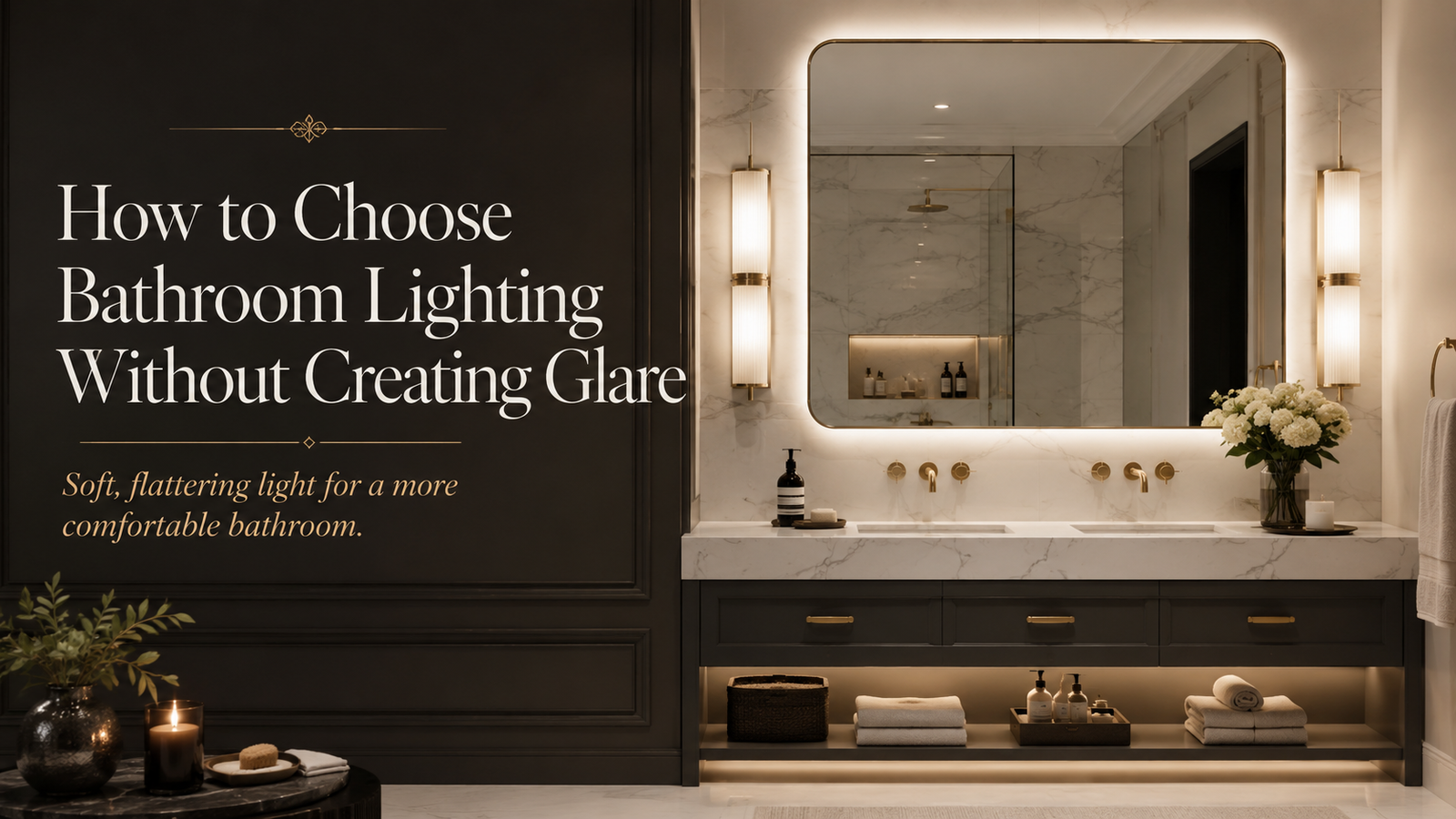
Installing wall lights on both sides of the mirror can provide more balanced facial illumination.
Side lighting helps direct light toward the face from multiple angles instead of concentrating everything from above.
For grooming tasks such as:
- Shaving
- Applying makeup
- Hair styling
- Skincare
balanced lighting can often be more useful than simply increasing brightness.
Single-light wall sconces work well for this configuration. The Vivio Milla 1-Light Sconce is compact at 6.25 inches wide with a clear glass shade, available in brushed nickel and matte black, and is damp-location rated for bathroom use. The Vivio Roma 1-Light Sconce takes a taller, more linear approach with its clear tube glass design. The Roma includes a T10 8.5W LED lamp at 4000K and is available in matte black, brushed nickel, and champagne gold.
Be Careful With Downward-Facing Vanity Lights

Downward-facing vanity lights provide strong illumination toward the mirror and countertop.
That can make them excellent for task lighting.
However, fixtures with exposed bulbs or highly transparent shades may produce more noticeable glare when pointed downward.
If you prefer downward-facing fixtures, look for shades that partially diffuse or shield the light source.
The Vivio Amara 3-Light Vanity takes a different approach to this problem. Its metal mesh shade partially shields the bulb, creating a more filtered quality of light compared with a wide-open clear glass shade. The mesh still allows plenty of output but reduces that concentrated glare you can get from a fully exposed source pointed downward. The Amara can also be installed with shades facing upward if the downward configuration still feels too direct.
You can also pair the vanity fixture with softer ceiling lighting so the vanity light does not have to provide all of the room's illumination.
Upward-Facing Lights Can Create Softer Illumination

Vanity fixtures that face upward direct light toward the ceiling.
The light then reflects back into the bathroom, creating softer ambient illumination.
Upward-facing lights can help provide:
- Reduced direct glare
- Softer shadows
- More relaxed lighting
- A comfortable overall glow
The tradeoff is that you may receive slightly less direct illumination on your face.
Several Vivio vanity fixtures - including the Milla series and Amara series - support both upward and downward mounting. That flexibility lets you try one orientation and switch if the other feels more comfortable in your bathroom.
For bathrooms where detailed grooming is important, combining upward-facing vanity lighting with another task light can create a better balance.
Pay Attention to Color Temperature

Color temperature also affects how comfortable bathroom lighting feels.
2700K-3000K
Produces a warm white appearance.
This range works particularly well for bathrooms designed to feel relaxing or spa-like.
3500K-4000K
Produces a more neutral or crisp appearance.
It can be useful around mirrors where accurate visibility is important for grooming.
The Vivio Soffi LED Rectangle Vanity uses a 4000K integrated LED source, placing it at the upper end of this range. Its seeded glass helps offset the crispness of the color temperature by softening the beam, which demonstrates how shade material and color temperature interact. The Soffi is available in brushed nickel, matte black, and matte gold.
Very cool lighting can sometimes feel harsher, particularly when combined with highly reflective surfaces.
Color temperature should therefore be considered alongside brightness, fixture placement, and glass type.
Choose Fixtures With Good Color Rendering
Brightness is only part of good vanity lighting.
A fixture with strong color rendering can make skin tones, makeup, clothing, and other colors appear more natural.
Look for lighting with a high Color Rendering Index, or CRI, particularly around the bathroom mirror.
Better color rendering may allow you to achieve comfortable visibility without feeling like you need excessively bright lighting.
Use Multiple Layers of Bathroom Lighting

One powerful fixture is rarely the best solution for an entire bathroom.
Instead, combine several types of lighting.
A balanced bathroom may include:
- Vanity lighting for grooming
- Ceiling lighting for general illumination
- Recessed lighting for additional coverage
- Shower lighting where appropriate
- Decorative lighting for atmosphere
Layered lighting reduces the contrast between extremely bright and dark areas.
That can make the entire bathroom feel more comfortable while reducing perceived glare.
Install Dimmer Controls When Possible

A dimmer gives you much greater control over bathroom brightness.
Bright lighting may be useful while getting ready in the morning, while softer illumination may feel more comfortable late at night.
Dimming also allows you to compensate if a fixture turns out to be brighter than expected after installation.
Before using a dimmer, confirm that the fixture, LED driver, and bulbs are compatible with dimming.
Consider Reflective Bathroom Surfaces

Bathrooms often contain more reflective materials than other rooms.
These may include:
- Large mirrors
- Glossy countertops
- Polished tile
- Chrome fixtures
- Glass shower doors
- Glossy cabinets
Light can reflect from these surfaces and create glare even when the fixture itself is not especially bright.
When your bathroom contains many reflective finishes, softer shades and more indirect lighting can help create better visual comfort.
Keep Light Sources Out of Direct Sightlines
Fixture placement can make a major difference.
Before installing a vanity light, consider where the bulb or LED source will sit relative to your eyes.
Ideally, you should receive the light without constantly looking directly into the brightest part of the fixture.
This is especially important with:
- Clear glass vanity lights
- Exposed-bulb fixtures
- High-output integrated LEDs
- Low ceilings
- Large mirrors
Small adjustments in mounting height can significantly change how comfortable the fixture feels.
Do Not Choose Bathroom Lighting Based Only on Lumens
Lumens tell you how much visible light a fixture produces, but they do not tell you whether that light will be comfortable.
Two fixtures with similar lumen output can feel very different depending on their:
- Shade material
- Beam direction
- Fixture height
- Number of light sources
- Glass transparency
- Color temperature
- Room size
Choose bathroom lighting based on light quality and distribution, not simply the highest lumen number.
Make Sure the Fixture Is Suitable for Bathroom Use
Bathrooms contain more humidity and moisture than many other rooms.
Before installation, check whether the fixture is rated appropriately for its intended location.
Fixtures installed near showers, tubs, or other wet areas may require specific location ratings.
Several current Vivio vanity fixtures are listed for damp locations, including the Milla series (available in 1-, 2-, 3-, and 4-light configurations), the Soffi LED Rectangle Vanity, the Roxton 3-Light Vanity, and the Gia barn-light vanity series.
Always follow the fixture manufacturer's installation instructions and applicable electrical requirements.
Final Thoughts
The best bathroom lighting should provide plenty of visibility without making the room feel harsh.
To minimize glare:
- Choose diffused or frosted shades when possible
- Avoid overly bright exposed bulbs
- Use balanced lighting around the mirror
- Consider upward versus downward fixture direction
- Pay attention to color temperature and CRI
- Layer several light sources
- Add dimming controls when compatible
- Consider reflections from mirrors, tile, and glass
- Position fixtures outside uncomfortable sightlines
Rather than simply making your bathroom brighter, focus on creating even, controlled illumination.
With the right fixture design and placement, you can create a bathroom that is comfortable for everyday grooming while still feeling polished, relaxing, and inviting.
Explore Vivio Lighting's current bathroom collection for vanity lights, wall sconces, and integrated LED fixtures designed for bathroom use.