

Glass vs. Metal Pendant Lights: Which Should You Choose?

Pendant lights can completely change the look of a kitchen island, dining table, entryway, or bar area. While fixture size and shape are important, the material of the pendant shade can have just as much influence on how the light looks and performs.
Two of the most common options are glass pendant lights and metal pendant lights.
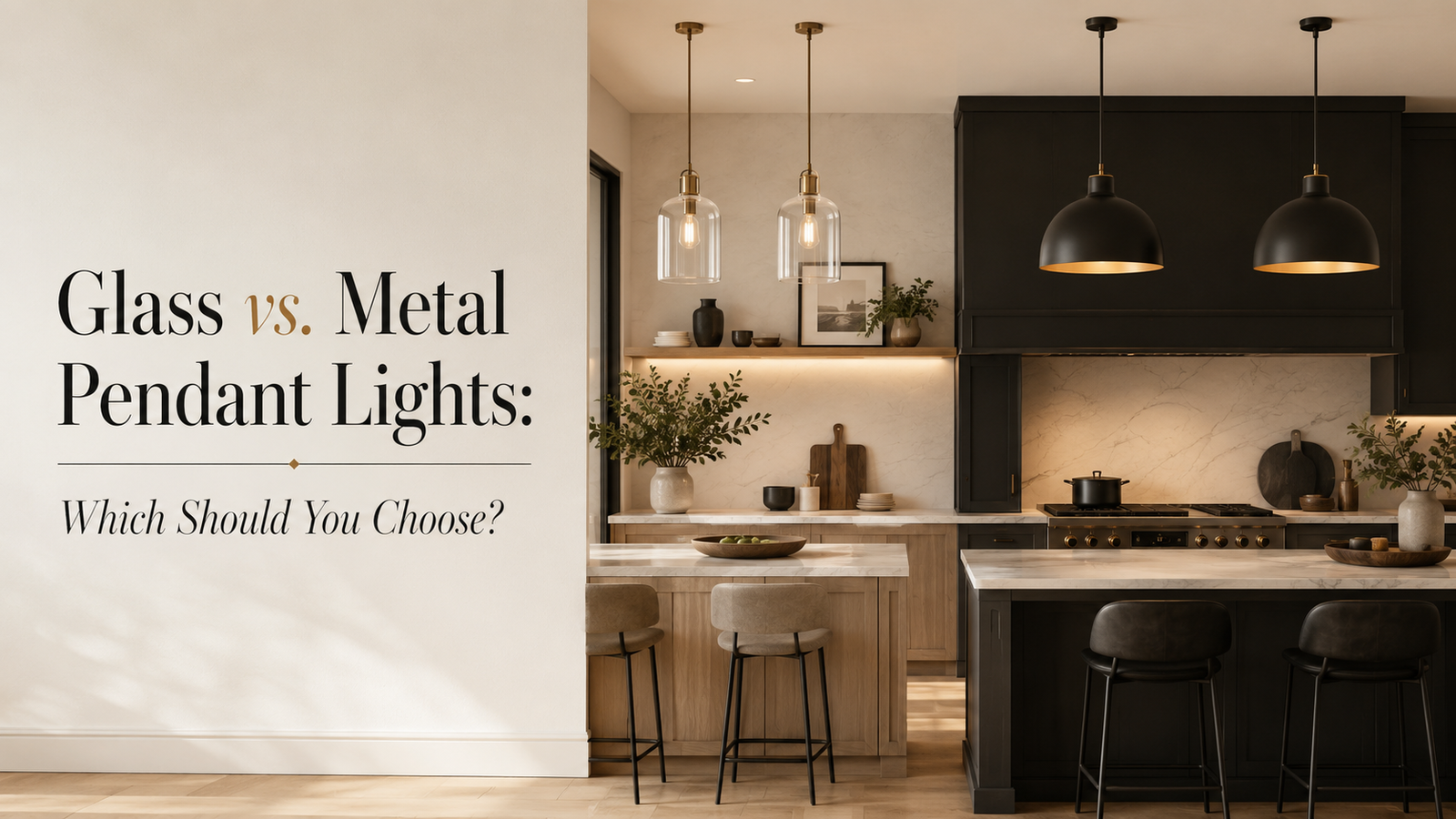
Glass pendants can create an open, airy appearance while allowing more light to spread throughout the room. Metal pendants usually provide a stronger visual presence and can direct light more intentionally toward the surface below.
Neither material is automatically better. The right choice depends on your room, lighting needs, decorating style, and how much visual weight you want the fixture to have.
Here is how glass and metal pendant lights compare.
Glass vs. Metal Pendant Lights at a Glance

| Feature | Glass Pendant Lights | Metal Pendant Lights |
|---|---|---|
| Appearance | Open, bright, airy | Bold, structured, substantial |
| Light distribution | Usually broader | Usually more directional |
| Visual weight | Lighter | Heavier |
| Best for | Open layouts, small spaces, decorative lighting | Islands, task lighting, statement designs |
| Sightlines | Generally excellent | Depends on shade size |
| Maintenance | Shows dust and fingerprints more easily | Often easier to keep looking clean |
| Style | Modern, transitional, contemporary, traditional | Industrial, modern, farmhouse, contemporary |
| Shade options | Clear, frosted, seeded, bubble | Dome, cone, cylinder, geometric |
| Vivio example | Soffi and Pixi illuminated glass fixtures | Alix and Mia metal shade pendants |
Why Choose Glass Pendant Lights?

Glass pendant lights are popular because they provide decorative interest without making the ceiling feel crowded.
Because you can often see through the fixture, glass pendants tend to have less visual weight than solid shades.
They can be especially useful in:
- Small kitchens
- Open-concept homes
- Kitchens with low or standard ceilings
- Dining areas
- Breakfast bars
- Rooms where preserving sightlines is important
Clear glass can almost disappear into the surrounding room while still creating a decorative focal point.
The Soffi 1-Light Illuminated Glass Cylinder is a good example of how little space a glass pendant can occupy. The seeded glass cylinder measures 6 inches across and the whole fixture reads as a lit shape rather than an object hanging in the room.
Glass Pendant Lights Allow More Light to Spread

One of the biggest differences between glass and metal pendants is how they distribute light.
Transparent or translucent glass allows light to travel through the sides of the fixture.
This can create illumination:
- Down toward a countertop or table
- Out toward nearby walls
- Across the surrounding room
- Up toward the ceiling
The result is often softer and more widespread than the light produced by a solid metal shade.
If the pendant is expected to contribute to the room's overall ambient lighting, glass can be an excellent option.
The Soffi 5-Light Illuminated Glass Cylinder shows what that looks like in practice. Five bubble glass cylinders on one canopy put out 2,261 lumens, and because the glass is lit from within, that light leaves the fixture in every direction rather than only downward.
Clear Glass vs. Frosted Glass

Not every glass pendant produces the same lighting effect.
Clear Glass
Clear glass exposes the bulb and allows the greatest amount of visible light to spread through the fixture.
It works particularly well when using an attractive decorative bulb.
Clear glass also creates an extremely open appearance, making it helpful above kitchen islands where you want to maintain sightlines.
Frosted Glass
Frosted or diffused glass softens the light before it enters the room.
This can help reduce glare and create a more comfortable glow.
Frosted glass works particularly well when the bulb or integrated LED would otherwise be highly visible.
Textured and Bubble Glass
Textured glass sits between the two. It passes light through the shade like clear glass while breaking up the view of the source inside.
Seeded glass, like the shade on the Soffi 1-Light, carries fine bubbles suspended in the material. Bubble glass, used on the Pixi 5-Light Illuminated Glass Cube and the larger Soffi cylinders, uses a heavier pattern that catches the light and gives the fixture more character when lit.
Smoked or Tinted Glass
Smoked glass provides a darker, more dramatic appearance.
It maintains some transparency while giving the pendant greater visual presence than completely clear glass.
However, darker glass may reduce the amount of light passing through the shade.
Glass Pendants Can Make Small Rooms Feel More Open

Large decorative lighting does not always work well in a small room.
A solid fixture may visually dominate the space even if its physical dimensions technically fit.
Glass helps solve this problem.
Because you can see through much of the fixture, a glass pendant can have a relatively large diameter without feeling as heavy.
For example, three transparent glass pendants may feel considerably lighter above a kitchen island than three solid metal domes of the same diameter.
This makes glass especially useful when you want noticeable fixtures without overwhelming the room.
Glass Is Excellent for Preserving Sightlines
 Pendant lights are commonly installed 30 to 36 inches above a kitchen island or dining surface, placing them directly within important sightlines.
Solid fixtures can sometimes block views across the room.
This may be noticeable when the island faces:
- A living room
- Dining room
- Television
- Large windows
- Outdoor space
- Additional seating
Clear glass allows you to see through the fixture, making it a strong choice for open-concept kitchens.
Open-frame metal fixtures can provide a similar advantage, but traditional solid metal shades generally block more of the view. The Vega 1-Light Cage Pendant and the Astra 1-Light Triangle Pendant both make this point: they are metal fixtures with nothing inside the frame, so you get the finish and structure of metal without the solid surface at eye level.
What Are the Downsides of Glass Pendant Lights?

Glass does require some additional consideration.
One of the biggest disadvantages is maintenance.
Clear glass can make the following more noticeable:
- Fingerprints
- Dust
- Cooking residue
- Water spots
- Smudges
Fixtures positioned near cooking surfaces may require more frequent cleaning.
Glass can also make the bulb highly visible.
The bulb becomes part of the fixture's appearance, so choosing the correct bulb shape and color temperature becomes especially important.
Integrated LED fixtures sidestep that particular problem. The Soffi and Pixi glass fixtures light the glass itself rather than housing a visible bulb, so there is no filament to shop for and no mismatch between the bulb you bought and the one in the product photo.
Why Choose Metal Pendant Lights?

Metal pendant lights usually create a stronger and more defined focal point.
Instead of allowing light to pass through the shade, metal blocks the light and directs it through the fixture's openings.
This often means more light travels downward toward the surface below.
Metal pendants are particularly well suited to:
- Kitchen islands
- Breakfast bars
- Work surfaces
- Industrial interiors
- Modern kitchens
- Farmhouse spaces
- Rooms that need stronger decorative contrast
A matte black metal pendant, for example, can immediately create definition against white cabinets or a light-colored ceiling.
The Alix 1-Light Large Metal Shade Pendant is the straightforward version of this idea: a 13-inch solid shade in matte black or brushed nickel, hung from a 36-inch downrod.
Metal Pendants Can Provide More Focused Light

Solid metal shades generally direct more light downward than transparent glass fixtures.
A dome or cone-shaped metal pendant can concentrate illumination over:
- Kitchen countertops
- Islands
- Tables
- Desks
- Bars
This makes metal particularly useful when pendant lighting serves a practical task-lighting purpose.
The narrower the shade opening, the tighter the pool of light. The Bullet Industrial Bullet Head Pendant sits at the extreme end at just 3.25 inches wide, while the Mia 12" Metal Shade Corded Pendant spreads that same downward light across a wider footprint.
However, the exact performance depends on the fixture.
Always consider:
- Shade shape
- Bulb type
- Lumens
- Fixture height
- Shade opening
- Interior shade finish
A pendant's material alone does not determine how much usable light it produces.
Metal Pendants Create Stronger Visual Contrast

Metal fixtures typically appear more substantial than glass.
That can be an advantage when you want pendant lighting to become a major design feature.
Popular finishes include:
- Matte black
- Brushed nickel
- Chrome
- Brass
- Champagne gold
- Bronze
- White
The finish can either coordinate with surrounding hardware or intentionally introduce contrast.
For example, matte black pendant lights can work particularly well with black cabinet pulls, faucets, window frames, or appliances.
Metal Pendants Can Make a Large Room Feel More Balanced

Very small or transparent fixtures can sometimes disappear within a large kitchen.
This is particularly common when the room has:
- A long kitchen island
- 9- or 10-foot ceilings
- Vaulted ceilings
- Large windows
- Oversized cabinetry
- Open floor plans
Larger metal pendants provide enough visual weight to balance these architectural features.
Two oversized metal pendants may look more proportional above a large island than three small glass pendants.
At that scale, open metal frames give you presence without a wall of solid shade. The Solano 4-Light Geometric Pendant measures 20 inches wide in matte black or champagne gold, and the Aura Strap Steel Sphere reaches 24 inches in its six-light version while remaining an open cage of steel straps.
The decision should always consider the scale of the entire room rather than the island alone.
Metal Pendants Are Often Easier to Maintain

Metal shades generally hide fingerprints and interior dust better than clear glass.
Matte and textured finishes are particularly forgiving.
This can make metal pendant lights practical in busy kitchens.
However, different finishes require different cleaning methods.
Avoid abrasive cleaners that could damage painted, plated, or brushed surfaces.
Do Glass Pendant Lights Provide More Light?

Not necessarily.
Glass often allows light to spread in more directions, but that does not automatically mean the fixture produces more light.
Actual output depends on:
- Bulb lumens
- Number of bulbs
- Integrated LED output
- Glass transparency
- Shade size
- Fixture height
- Beam spread
A metal pendant with a powerful LED source may provide significantly more usable light than a decorative clear glass pendant with a low-output bulb.
Two Vivio fixtures make the point clearly. The Soffi 5-Light glass cylinder and the Tivoli Large LED 18" Square Pendant both run on a 35W integrated LED. The glass fixture is rated at 2,261 lumens and the metal one at 1,305. Same wattage, very different output, and you would not know that from the material or the size.
When comparing fixtures, look at lumens rather than simply judging brightness by fixture material or physical size.
Which Is Better Over a Kitchen Island?

Both materials can work extremely well above kitchen islands.
The better option depends on what you want the pendants to accomplish.
Choose Glass Pendants When:
Glass may be the better option when:
- You want the kitchen to feel open.
- Maintaining sightlines is important.
- The kitchen is relatively small.
- You want light to spread throughout the space.
- You prefer a lighter visual appearance.
- Decorative bulbs are part of the design.
- Your kitchen already contains several visually heavy elements.
Choose Metal Pendants When:
Metal may be better when:
- You want stronger downward illumination.
- The pendants need to become a focal point.
- You have a large kitchen island.
- You want strong contrast.
- Your design is modern, industrial, or farmhouse inspired.
- You want the fixtures to feel substantial.
- Easy everyday maintenance is a priority.
A useful way to test this: picture the same island with three Soffi cylinders and then with three Alix shades. The glass version keeps the ceiling quiet and lets you see the room behind it. The metal version turns the island into the thing you look at first. Both are correct answers to different questions.
Which Material Works Better in a Small Kitchen?

Glass frequently has the advantage in smaller kitchens.
Transparent materials allow the eye to travel through the fixture rather than stopping at a solid shade.
This can make the ceiling feel less crowded.
Slim metal pendants can still work very well, though.
A narrow cylinder or small dome can provide the durability and contrast of metal without overwhelming the room. The Bullet pendant at 3.25 inches and the Salerno Mesh Cylinder Pendant at 8 inches both stay narrow enough to group without crowding.
Fixture size and shape remain just as important as material.
Which Material Works Better With High Ceilings?

High ceilings often benefit from fixtures with greater visual presence.
Metal shades can provide this naturally because they appear more substantial.
However, larger glass pendants can also fill vertical space while maintaining an open appearance.
For vaulted or extra-high ceilings, pay attention to:
- Fixture height
- Maximum suspension length
- Cord or downrod adjustability
- Sloped-ceiling compatibility
- Overall pendant diameter
Check the maximum drop before anything else. The cord-hung Soffi and Pixi glass fixtures extend to 132 inches, which covers most vaulted installations. Downrod fixtures like the Alix ship with a fixed 36 inches of rod, so a tall ceiling may need additional rod sections ordered separately.
A pendant that looks large in product photography can appear surprisingly small when installed beneath a tall ceiling.
Consider the Bulb Before Choosing Glass

The bulb matters more with clear glass than with most metal shades.
Since the bulb remains visible, consider its:
- Shape
- Filament design
- Color temperature
- Brightness
- Base
- Dimming capability
Decorative LED filament bulbs are often paired with clear glass because they contribute to the fixture's overall appearance.
This is also where the two categories diverge on cost of ownership. An E26 fixture like the Alix or Mia lets you swap bulbs whenever you want a different look or brightness. An integrated LED fixture like the Soffi or Pixi decides that for you at purchase, which is simpler up front and less flexible later.
Also consider glare.
A very bright exposed bulb installed near eye level can become uncomfortable.
Using a dimmer or choosing frosted glass can help soften the effect.
Consider Color Temperature
Color temperature can significantly change how either material looks.
For residential pendant lighting, 2700K to 3000K generally creates a warm and comfortable appearance.
Warmer lighting can:
- Enhance gold and brass finishes
- Soften matte black fixtures
- Create warmer reflections in clear glass
- Make dining and living spaces feel more inviting
Cooler white lighting can create a cleaner, more contemporary appearance, especially around chrome, nickel, white, and black finishes.
Integrated LED fixtures lock this in, so check the number before you buy rather than after. Even within one collection it varies: the Soffi 1-Light runs at 3000K while the multi-light Soffi and Pixi fixtures run at 4000K, which is a visibly cooler, crisper light.
Try to coordinate your pendant lighting with nearby recessed lighting, under-cabinet lighting, and decorative fixtures.
Can You Mix Glass and Metal Pendant Lights?

Yes.
Many pendant designs actually combine both materials.
A fixture might use:
- A glass shade with a black metal frame
- Clear glass with brass hardware
- Frosted glass with brushed nickel
- Glass globes suspended from metal rods
- Metal cages surrounding glass shades
Combining materials can provide the best characteristics of both.
The Salerno pendant is the clearest illustration: a glass shade set inside a matte black mesh outer frame, so the light diffuses through glass while the fixture still reads as a metal object. The Ravenna 4-Light Semi Flush Mount works the same way at a larger scale, hanging four clear acrylic shades inside an open 20-inch drum frame in matte black or brushed nickel.
You can get the open appearance and light distribution of glass while using metal details to visually connect the fixture with other finishes throughout the room.
Coordinate With Nearby Fixtures
Your pendant lights do not necessarily need to match every fixture in the house.
However, they should feel intentional when viewed together.
In an open floor plan, you may be able to see the kitchen pendants, dining chandelier, and living room lighting simultaneously.
Try repeating one or two design elements such as:
- Finish
- Glass style
- Fixture shape
- Color temperature
- Geometric details
For example, glass kitchen pendants with matte black hardware can coordinate naturally with a matte black dining chandelier without requiring the fixtures to be from the same collection.
The Pixi glass cubes in matte black and the Vega metal cages in matte black are a working example of that idea. Different materials, different shapes, same finish, and they read as deliberate together.
Glass vs. Metal Pendant Lights: Which Should You Choose?
There is no single correct material for every room.
Glass pendant lights are an excellent choice when you want an open appearance, broad light distribution, and minimal interruption of sightlines.
Metal pendant lights work particularly well when you want directional lighting, stronger visual contrast, and a fixture with greater decorative weight.
For many homes, the best solution is somewhere in between.
Fixtures combining glass and metal can provide transparency while still introducing enough structure and finish to connect the lighting with the rest of the room.
Before making your decision, consider the pendant's:
- Size
- Shape
- Light output
- Shade transparency
- Finish
- Hanging height
- Location
- Relationship with nearby fixtures
The goal is not simply to choose between glass and metal. It is to choose a pendant that provides the right balance of light, proportion, and style for your space.
Frequently Asked Questions
Are glass pendant lights hard to keep clean?
Clear glass typically shows dust, fingerprints, and cooking residue more easily than metal. Regular cleaning can keep the fixture looking clear and bright.
Are metal pendant lights too dark for a kitchen?
Not necessarily. Metal shades may direct more light downward instead of allowing it to spread through the sides. Proper lumen output and surrounding recessed or under-cabinet lighting can keep the kitchen bright.
Are glass pendants better for small kitchens?
They can be. Transparent glass creates less visual obstruction, which can help smaller kitchens feel more open.
Do pendant lights need to match cabinet hardware?
No. Matching finishes can create consistency, but complementary finishes can also work well. Repeating a finish elsewhere in the room usually makes the design feel intentional.
Can you use glass pendant lights over a kitchen island?
Yes. Glass pendants are especially popular above islands because they provide decorative lighting without heavily blocking sightlines.
Can you mix glass pendants with a metal chandelier?
Yes. Try creating a connection between the fixtures through a shared finish, shape, color temperature, or design detail rather than making every fixture identical.
Is an integrated LED glass pendant better than one that takes bulbs?
Neither is better across the board. Integrated LED fixtures give you a known lumen and Kelvin figure with no bulb shopping, which suits glass shades where the source is visible. Bulb-based fixtures let you change brightness and warmth later, and let you replace a single component instead of the whole fixture.
Final Thoughts
Choosing between glass and metal pendant lights comes down to how you want the fixture to interact with the room.
Glass tends to feel lighter, brighter, and more open, while metal tends to feel stronger, more directional, and more architectural.
Consider the size of the room, ceiling height, available natural light, desired brightness, nearby fixtures, and the visual impact you want the pendant to create.
When all of those elements work together, either glass or metal pendant lighting can become a beautiful and functional part of your home.
Browse the full range of Vivio Lighting pendant lights to compare glass, metal, and combination fixtures side by side.