
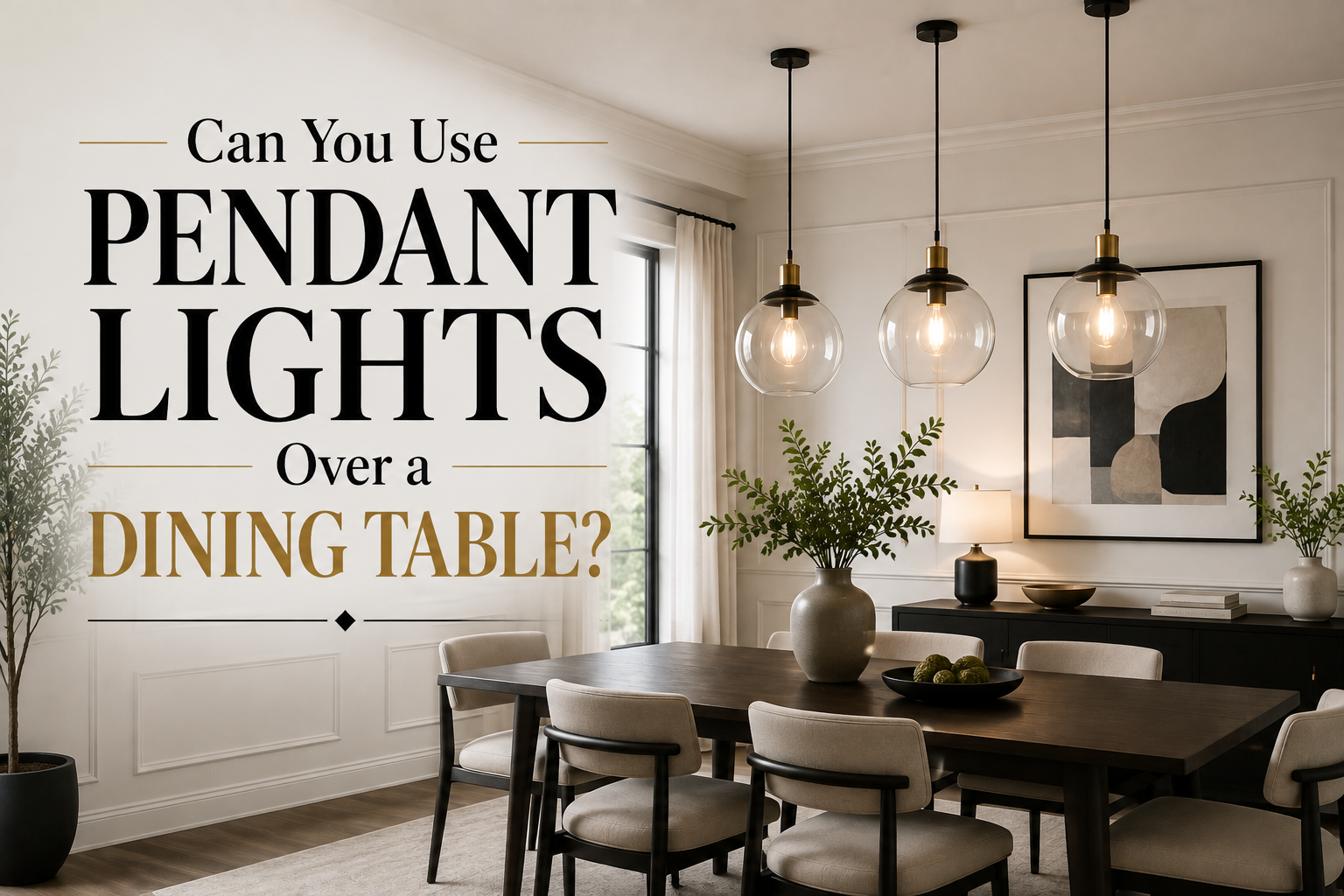

Can You Use Pendant Lights Over a Dining Table?
Yes, pendant lights can absolutely be used over a dining table.
While chandeliers are traditionally associated with dining rooms, pendant lights can provide the same combination of illumination and decorative impact. In many modern, contemporary, industrial, and minimalist spaces, pendants can even feel more natural than a traditional chandelier.
The key is choosing the right size, number, shape, spacing, and hanging height for the table below.
Whether you are considering one oversized pendant, two matching fixtures, or a linear arrangement of smaller pendants, this guide will help you create a balanced dining room lighting layout.
Are Pendant Lights Good for Dining Rooms?

Pendant lights are an excellent choice for dining rooms because they bring the light source closer to the table while creating a clear visual focal point.
They can provide:
- Focused lighting over the dining surface
- Decorative interest
- Better definition of the dining area
- A more intimate atmosphere
- Flexibility in modern and open-concept spaces
- An alternative to traditional chandeliers
Pendant lighting works especially well when the dining table is part of a larger open floor plan because the fixture can visually separate the dining zone without adding walls or partitions.
Pendant Light vs. Chandelier Over a Dining Table

Both pendant lights and chandeliers can work beautifully over a dining table.
The main difference is usually their visual structure.
A chandelier typically combines several lights into one larger decorative fixture. Pendants are often simpler fixtures suspended individually from the ceiling.
Choose Pendant Lights When:
- You prefer a clean or contemporary appearance
- You want multiple fixtures over a long table
- You like minimalist lighting
- You want greater flexibility with spacing
- You are lighting a narrow rectangular table
- You want the dining area to feel less formal
Choose a Chandelier When:
- You want one dramatic centerpiece
- The room has a traditional or transitional design
- The dining table is round or square
- You want a fixture with greater decorative detail
There is no rule saying a dining room must have a chandelier. The fixture simply needs to feel proportional to the table and surrounding room.
The two approaches sit side by side in most collections. The Alph 6-Light Flat Bottom Chandelier takes the chandelier route with six candle-style lights on a 25.25-inch frame, while the Soffi 5-Light Linear Pendant takes the pendant route with a single clean bar of integrated LED light. Both work over the same table. They simply say different things about the room.
How High Should Pendant Lights Hang Over a Dining Table?

A useful starting point is:
30 to 36 inches above the dining table.
Measure from the tabletop to the bottom of the pendant.
This height generally keeps the fixture close enough to create an intimate dining atmosphere while leaving enough space for comfortable conversations and sightlines across the table.
You may need to adjust the height depending on:
- Ceiling height
- Pendant size
- Fixture shape
- User height
- Dining table dimensions
- Light distribution
- Surrounding furniture
With ceilings higher than eight feet, pendants can sometimes be positioned slightly higher while still maintaining a strong visual connection to the table.
Check the adjustment range before you buy. Chain-hung fixtures such as the Alph chandeliers ship with up to 10 feet of chain and wire, which gives you room to work with a vaulted ceiling. Cord-hung pendants adjust continuously but usually have a shorter maximum drop.
How Big Should a Pendant Light Be Over a Dining Table?

Pendant size should be determined primarily by the dimensions of the dining table rather than the overall room.
For a single pendant, a helpful starting point is choosing a fixture approximately:
One-half to two-thirds the width of the table.
For example, a 42-inch-wide dining table may work well with a pendant approximately 20 to 28 inches wide, depending on its design.
Fixture shape also matters.
An airy open-frame pendant may look visually lighter than a solid metal pendant with the exact same dimensions.
Always consider both the actual measurements and the visual weight of the fixture.
Can You Use One Pendant Over a Dining Table?

Absolutely.
One pendant can create a clean, centered focal point over the dining table.
A single pendant works particularly well when:
- The table is round
- The table is square
- The fixture is relatively large
- You want a minimalist appearance
- The pendant has enough light output
- The dining area is relatively compact
One oversized pendant can also create the dramatic presence normally associated with a chandelier without introducing multiple arms or decorative elements.
The Elio 24" LED Halo Acrylic Lens Pendant is built for exactly this job. At 23.5 inches across in brushed nickel, it lands inside the range you would want over a 42-inch table, and the acrylic lens spreads light across the whole surface rather than dropping it in one spot.
Can You Use Two Pendant Lights Over a Dining Table?

Two pendant lights can be an excellent option over rectangular or oval dining tables.
Using two fixtures creates symmetry while spreading light more evenly across the length of the table.
Two pendants are especially effective when:
- The dining table is long
- The fixtures are medium or large
- You want a balanced modern appearance
- One central pendant would leave the ends of the table poorly illuminated
- Three fixtures would make the ceiling look crowded
Position the pendants evenly so the complete arrangement remains centered over the table.
At this quantity you want each fixture in the 12-inch range rather than the 20-inch range. Two Tivoli Small LED 12" Square Pendants give you a pair of clean geometric shapes, and two Parma Metal and Mesh Globe Pendants do the same with a softer profile.
Can You Use Three Pendant Lights Over a Dining Table?

Yes. Three smaller pendants can look particularly attractive over a long rectangular dining table.
Repeating the same fixture creates rhythm and can emphasize the length of the table.
Three pendants generally work best when:
- The table is medium to long
- The individual fixtures are relatively narrow
- You want even light distribution
- The room has a contemporary design
- The pendants have a simple profile
Avoid squeezing three large pendants into a space that would look cleaner with one or two larger fixtures.
The size of the pendants should determine the quantity, not the other way around.
For a row of three, the Soffi 1-Light Illuminated Glass Cylinder is about as narrow as this gets. Each seeded glass cylinder is 6 inches across, so three of them together occupy less horizontal space than a single 20-inch fixture.
How Far Apart Should Dining Room Pendants Be?

When using multiple pendant lights, a useful starting point is approximately:
24 to 30 inches between the centers of the fixtures.
The exact distance depends on pendant size.
Larger fixtures need additional breathing room, while narrow pendants may be positioned slightly closer together.
You can also consider maintaining approximately:
12 to 18 inches of clear space between neighboring fixtures.
The goal is to create one coordinated lighting arrangement rather than several unrelated fixtures hanging above the table.
Center the Pendants Over the Table, Not the Room

One of the most important dining room lighting rules is to center the fixture over the table rather than the entire room.
Dining tables are not always positioned perfectly in the middle of the room.
If the table is slightly off-center because of:
- A walkway
- Built-in cabinetry
- Doors
- Windows
- Nearby furniture
- An open-concept layout
the pendant lighting should normally move with the table.
The visual relationship between the lighting fixture and the furniture beneath it is more important than perfect alignment with the ceiling.
Match the Pendant Shape to the Dining Table

Fixture shape can help reinforce the proportions of the table below.
Round Dining Tables
Round tables often look balanced with:
- One large globe
- A circular pendant
- A dome pendant
- A sculptural central fixture
Keeping the light centered reinforces the symmetry of the table.
The Aura Strap Steel Sphere is a natural fit here, and it comes in two sizes so you can scale it to the table: an 18-inch four-light version and a 24-inch six-light version, both in matte black with champagne gold or brushed nickel candle covers. The Elio halo pendant offers the same circular logic in a flatter, more contemporary form.
Rectangular Dining Tables
Long tables provide more flexibility.
Consider:
- Two medium pendants
- Three smaller pendants
- One linear pendant
- One oversized horizontal fixture
A longer lighting arrangement can help visually follow the shape of the table.
The Soffi 5-Light Linear Pendant handles this with one integrated LED bar in matte black, brushed brass, or brushed nickel. For a longer table that can carry more presence, the Kosi 10-Light Candelabra Island Pendant runs ten candelabra lights along a single linear frame in matte black or champagne gold.
Square Dining Tables
Square tables generally work well with a single centered pendant.
Geometric, round, globe, or square fixtures can all complement the balanced proportions of the table.
Matching the fixture shape to the table is the easiest version of this. The Tivoli Large LED 18" Square Pendant is an open 18-inch square in matte black, so it echoes the table without adding a solid shade overhead.
Leave Space Around the Ends of the Table

Pendant lights usually should not extend all the way to the ends of the dining table.
Leaving open space around the fixtures keeps the arrangement from feeling crowded.
A useful starting point is approximately:
12 to 18 inches between the end of the table and the center of the nearest pendant.
Larger fixtures may require more space.
The exact measurement should be adjusted according to the diameter of the pendants and overall table length.
Avoid Blocking Sightlines

Dining room lighting should create atmosphere without interfering with conversations.
Before installing a large pendant, sit at the dining table and consider how the fixture will affect views across the room.
Pay particular attention to views toward:
- Other diners
- The kitchen
- Living areas
- Artwork
- Windows
- Televisions
- Outdoor spaces
Clear glass, open-frame, narrow cylinder, and minimalist pendant designs can be particularly helpful when maintaining sightlines is important.
This is where an open fixture earns its keep. The Aura sphere reads as a large shape from across the room but is built from open steel straps, so you can see straight through it. The same applies to the open Tivoli square and the slim Soffi cylinders.
Consider Light Output, Not Just Fixture Size

A large pendant does not automatically produce more light.
Lighting performance depends on factors such as:
- Lumens
- Number of bulbs
- Bulb output
- Integrated LED output
- Shade material
- Shade direction
- Fixture height
- Beam spread
Dining rooms usually benefit from comfortable ambient lighting rather than extremely bright task lighting.
A dimmable fixture is especially useful because it lets you increase brightness for everyday activities and lower it during dinners or gatherings.
For a sense of scale, the Elio halo pendant produces 2,366 lumens from a 35W integrated LED. That is a measured, published number, which makes it much easier to plan around than a fixture rated only by how many bulbs it accepts.
Use a Dimmer for Dining Room Pendant Lights

Adding a compatible dimmer can make dining room pendant lighting significantly more versatile.
Higher brightness can be useful for:
- Cleaning
- Homework
- Working at the table
- Family activities
- Setting the table
Lower brightness can create a softer atmosphere for:
- Dinner
- Entertaining
- Holidays
- Evening gatherings
Always verify that the fixture and bulbs are compatible with the dimming system you plan to use.
Integrated LED fixtures are the ones to check most carefully, since you cannot swap in a dimmable bulb later. Both the Elio halo pendant and the Tivoli square pendants are listed as dimmable, so the dimming lives in the fixture itself.
Consider the Color Temperature

Color temperature also affects the atmosphere of a dining room.
Warm white lighting is generally well suited to dining spaces because it creates a comfortable and inviting appearance.
Around 2700K to 3000K is a popular range for residential dining areas.
Cooler lighting can create a cleaner, more contemporary appearance, but extremely cool color temperatures may make a dining room feel less intimate.
Try to coordinate the pendant color temperature with nearby kitchen, living room, and accent lighting, especially in an open-concept home.
The Elio pendant runs at 3000K and the Soffi 1-Light cylinder does the same, which puts both at the warm end of that range without drifting amber.
Coordinate Pendants With Nearby Fixtures
The dining pendant does not need to perfectly match every fixture in the home.
However, nearby lighting should feel intentional together.
Consider finishes already used on:
- Kitchen pendant lights
- Chandeliers
- Ceiling fans
- Cabinet hardware
- Faucets
- Door hardware
- Wall sconces
Popular finishes such as matte black, brushed nickel, chrome, brass, and champagne gold can help connect the dining fixture with surrounding elements.
Multi-finish fixtures make this easier. The Alph chandeliers come in matte black, matte gold, and brushed nickel, and the Soffi linear pendants come in matte black, brushed brass, and brushed nickel. Picking the finish you already have beats trying to work around one you do not.
Mixing finishes can work beautifully as long as the overall combination feels deliberate.
Pendant Lights Work Especially Well in Open-Concept Spaces
Pendant lighting can be particularly effective when the dining area shares space with a kitchen or living room.
A pendant arrangement creates a visual boundary around the dining table without physically dividing the room.
If there are already pendant lights above a nearby kitchen island, however, avoid making both areas equally dramatic.
You may want:
- Statement kitchen pendants with simpler dining lighting
- Simple kitchen pendants with a statement dining fixture
- Related fixtures in different sizes
- Different fixture styles connected by the same finish
Staying within one collection is the simplest way to get related fixtures at different scales. The Soffi family runs from a single 6-inch glass cylinder up to the 5-light linear pendant, so you can put small cylinders over the island and the linear bar over the table and have the two zones read as one plan.
This keeps the open space coordinated without making it look overly matched.
Common Mistakes to Avoid
When installing pendant lights over a dining table, avoid:
- Hanging the pendants too high
- Hanging them low enough to block conversations
- Choosing fixtures that are too small for the table
- Crowding multiple oversized pendants together
- Centering the lighting over the room instead of the table
- Ignoring the width of the dining table
- Choosing appearance without considering light output
- Forgetting about nearby decorative fixtures
- Using fixtures that cannot be dimmed when adjustable lighting is important
Planning the complete arrangement before installation can prevent most of these problems.
Dining Table Shapes and Fixture Types at a Glance
| Table Shape | Best Fixture Approach | Vivio Example |
|---|---|---|
| Round | One globe or circular fixture, centered | Aura Strap Steel Sphere |
| Round, modern | One flat circular LED pendant | Elio 24" LED Halo Pendant |
| Rectangular | One linear fixture following the length | Soffi 5-Light Linear Pendant |
| Long rectangular | One larger linear fixture | Kosi 10-Light Island Pendant |
| Square | One centered fixture echoing the shape | Tivoli Large LED 18" Square Pendant |
| Any, traditional | One multi-light chandelier | Alph 6-Light Flat Bottom Chandelier |
| Long, minimalist | Three narrow pendants in a row | Soffi 1-Light Glass Cylinder |
So, Can You Use Pendant Lights Over a Dining Table?
Yes. Pendant lights are an excellent alternative to chandeliers over dining tables.
One large pendant can create a dramatic central focal point, while two or three smaller pendants can provide symmetry and more even illumination across a longer table.
For a balanced starting point:
- Hang pendants approximately 30–36 inches above the tabletop
- Size the fixture according to the table rather than the entire room
- Keep multiple pendants evenly spaced
- Leave breathing room around the ends of the table
- Center the lighting arrangement over the table
- Consider sightlines and light output
- Use dimmable lighting when possible
Most importantly, choose lighting that feels proportional to both the dining table and the surrounding space.
Whether your dining room is modern, minimalist, transitional, industrial, or contemporary, the right pendant lights can turn the table into a natural focal point while providing comfortable illumination for everyday meals and special occasions.
Shop Dining Room Pendant Lights
Looking for lighting for your dining area? Explore Vivio Lighting pendant lights to find modern designs for round, square, rectangular, and open-concept dining spaces.