
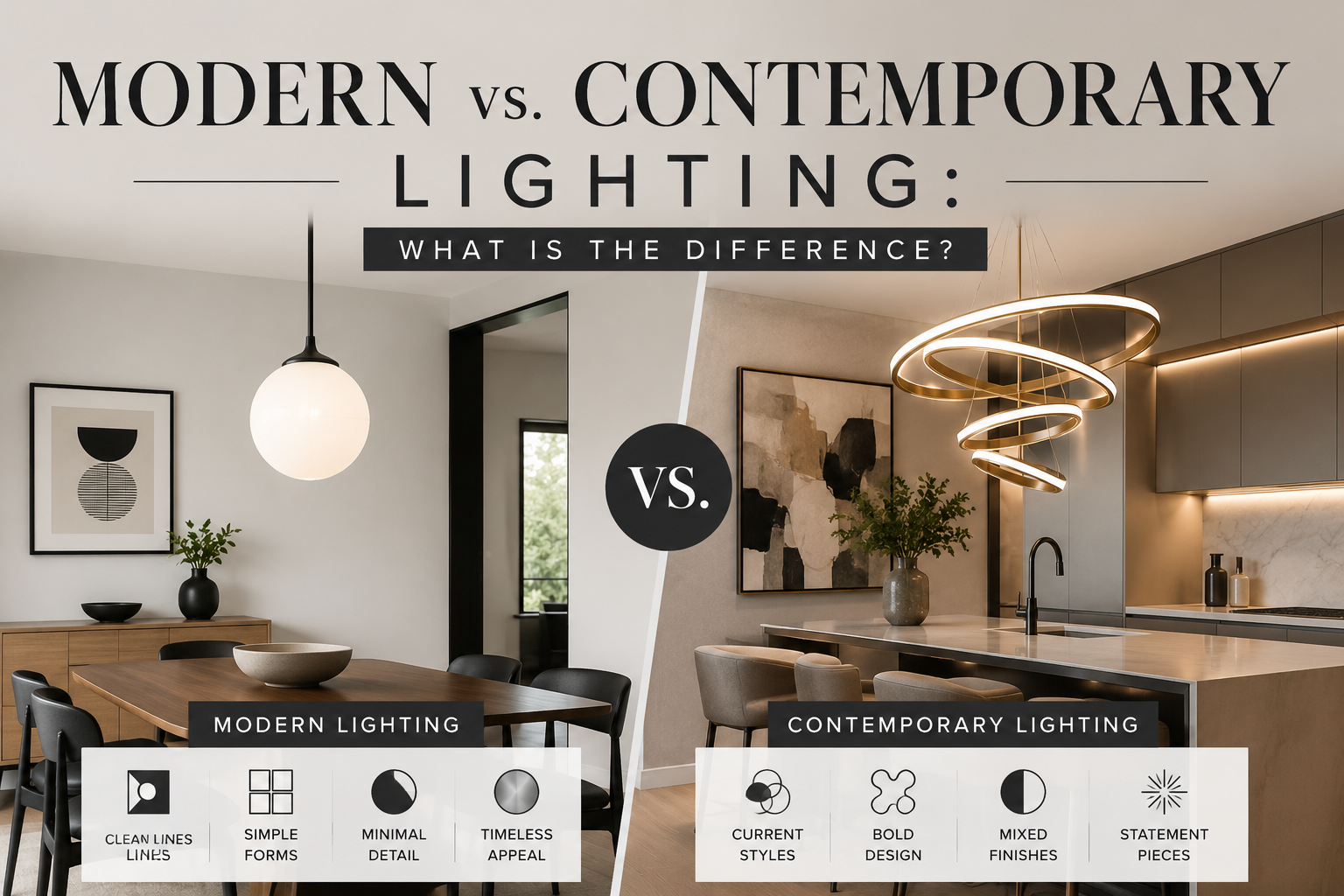

Modern vs. Contemporary Lighting: What Is the Difference?

The terms modern lighting and contemporary lighting are often used interchangeably, but they do not describe exactly the same style.
Modern lighting generally refers to a specific design movement with recognizable characteristics, while contemporary lighting reflects the styles and trends that are popular today.
Understanding the difference can make it easier to choose fixtures that fit the overall look of your home.
What Is Modern Lighting?

Modern lighting is influenced by modern design movements that became popular during the early to mid-20th century.
The style typically focuses on clean lines, simple shapes, and minimal decoration.
Common characteristics of modern lighting include:
- Straight, clean lines
- Geometric shapes
- Minimal ornamentation
- Matte black, chrome, or brushed metal finishes
- Glass and metal construction
- Simple, functional designs
Modern fixtures often have a structured appearance that works particularly well in minimalist, mid-century, industrial, and modern interiors.
What Is Contemporary Lighting?

Contemporary lighting refers to designs that reflect current styles.
Unlike modern design, contemporary style is constantly changing. A fixture considered contemporary today may look different from one designed several decades from now.
Contemporary lighting often includes:
- Sculptural shapes
- Integrated LED technology
- Mixed materials and finishes
- Oversized or dramatic designs
- Thin geometric frames
- Black, gold, brass, or neutral finishes
Because contemporary design evolves with current trends, it can incorporate elements from modern, minimalist, industrial, and luxury styles.
Modern vs. Contemporary Lighting

The biggest difference is that modern lighting follows an established design style, while contemporary lighting reflects what is currently popular.
Modern fixtures tend to be simpler and more structured. Contemporary fixtures may experiment more with unusual shapes, materials, finishes, and lighting technology.
For example, a simple matte black dome pendant - like the Vivio Mia 1-Light Pendant - has a modern appearance because of its clean geometric form and single-finish construction. A ring-shaped integrated LED fixture - like the Vivio Elio 24-inch LED Halo Pendant - feels more contemporary because of its sculptural shape and built-in LED technology.
Common Modern Lighting Fixtures
Certain fixture types naturally fit a modern design style.
Popular choices include:
- Globe pendants
- Linear chandeliers
- Simple flush mounts
- Metal dome pendants
- Minimal wall sconces
- Open-frame fixtures
These designs usually focus on proportion and shape rather than decorative detailing.
The Vivio Alix 1-Light Pendant is a straightforward example. Its dome-shaped metal shade, clean silhouette, and single E26 bulb keep the focus on form rather than decoration. The Alix is available in matte black and brushed nickel - both classic modern finishes. The Vivio Parma 1-Light Globe Pendant in brushed nickel follows the same principle with a mesh globe shape.
For flush mounts, the Vivio Vincent 2-Light Flush Mount uses a simple open square frame that reads as modern without relying on any ornamentation. The Vivio Roma 1-Light Sconce fills the minimal wall sconce role with its clear tube glass and restrained design, available in matte black, brushed nickel, and champagne gold.
Modern lighting is especially easy to coordinate throughout a home because simple forms can be repeated in kitchens, bathrooms, hallways, and living spaces.
Common Contemporary Lighting Fixtures

Contemporary fixtures often act as stronger visual features within a room.
Popular examples include:
- LED ring chandeliers
- Multi-ring fixtures
- Sculptural pendants
- Geometric chandeliers
- Asymmetrical lighting
- Minimal integrated LED fixtures
The Vivio Elio 24-inch LED Halo Pendant is a good example of a contemporary LED ring fixture. Its ring-shaped acrylic lens produces 2,366 lumens from a 35W integrated LED at 3000K, and the entire fixture is dimmable. The Elio's shape and technology are both distinctly current - this is not a form that existed in mid-century modern design.
The Vivio Kaleesi 5-Light Pendant represents the sculptural end of contemporary design. Its twisted spiral cage creates a dramatic silhouette at nearly 31 inches wide, making it a clear statement piece for dining rooms or entryways.
The Vivio Odyssey 6-Light Sputnik Chandelier sits at an interesting point between both categories. The sputnik form originated in mid-century modern design, but contemporary versions often update it with two-tone finishes - the Odyssey is available in matte black with champagne gold or brushed nickel accents.
These designs can work particularly well in open-concept homes, dining rooms, entryways, and living rooms where the fixture can become part of the room's overall design.
How Finishes Affect the Style

Finish can also influence whether a fixture feels more modern or contemporary.
Matte black, brushed nickel, and chrome often create a clean modern appearance.
Contemporary spaces may use these same finishes but are also more likely to incorporate:
- Champagne gold
- Brushed brass
- Mixed black and gold
- Two-tone finishes
- Warm metallic accents
The Vivio Alix pendant in matte black reads as modern because it uses a single, neutral finish. The Vivio Aura 5-Light Chandelier in matte black with champagne gold reads as more contemporary because the two-tone metallic combination feels current. The same holds true at the vanity scale - the Vivio Milla 3-Light Vanity in matte black has a clean modern quality, while the Vivio Kira 3-Light Vanity mixes matte black with gold accents for a more contemporary edge.
You do not necessarily need to use the same finish throughout the entire room. Repeating one or two finishes can create consistency while still allowing different fixture styles.
Can Modern and Contemporary Lighting Be Mixed?
Yes.
Modern and contemporary fixtures often work well together because both styles typically emphasize clean lines and uncluttered design.
For example, you could combine:
- Modern black pendants over a kitchen island
- A contemporary LED chandelier over the dining table
- Minimal wall sconces in nearby spaces
- Simple recessed lighting for general illumination
A home might use Mia dome pendants - with their clean modern profile - grouped above a kitchen island, while an Elio LED Halo or Aura 5-Light chandelier acts as a more contemporary focal point in the adjacent dining area. Roma sconces in a shared finish can tie the spaces together.
Keeping similar finishes, shapes, or materials throughout the room can help different fixture styles feel connected.
Which Style Is Better for Your Home?
The better choice depends on the look you want to create.
Choose modern lighting if you prefer clean, simple fixtures with timeless geometric shapes and minimal decoration.
Choose contemporary lighting if you prefer current trends, sculptural designs, integrated LEDs, or fixtures that make a stronger visual statement.
You can also combine both styles to create a space that feels current without becoming overly trendy.
Final Thoughts
Modern and contemporary lighting may look similar, but they have different design foundations.
Modern lighting is based on an established design movement known for simplicity, clean lines, and functional forms. Contemporary lighting changes with current design trends and often includes newer materials, finishes, and technology.
Understanding the difference can help you select lighting that complements your space while creating a more consistent overall design.
Explore Vivio Lighting's pendant collection and chandelier collection across modern, contemporary, farmhouse, and industrial styles.