
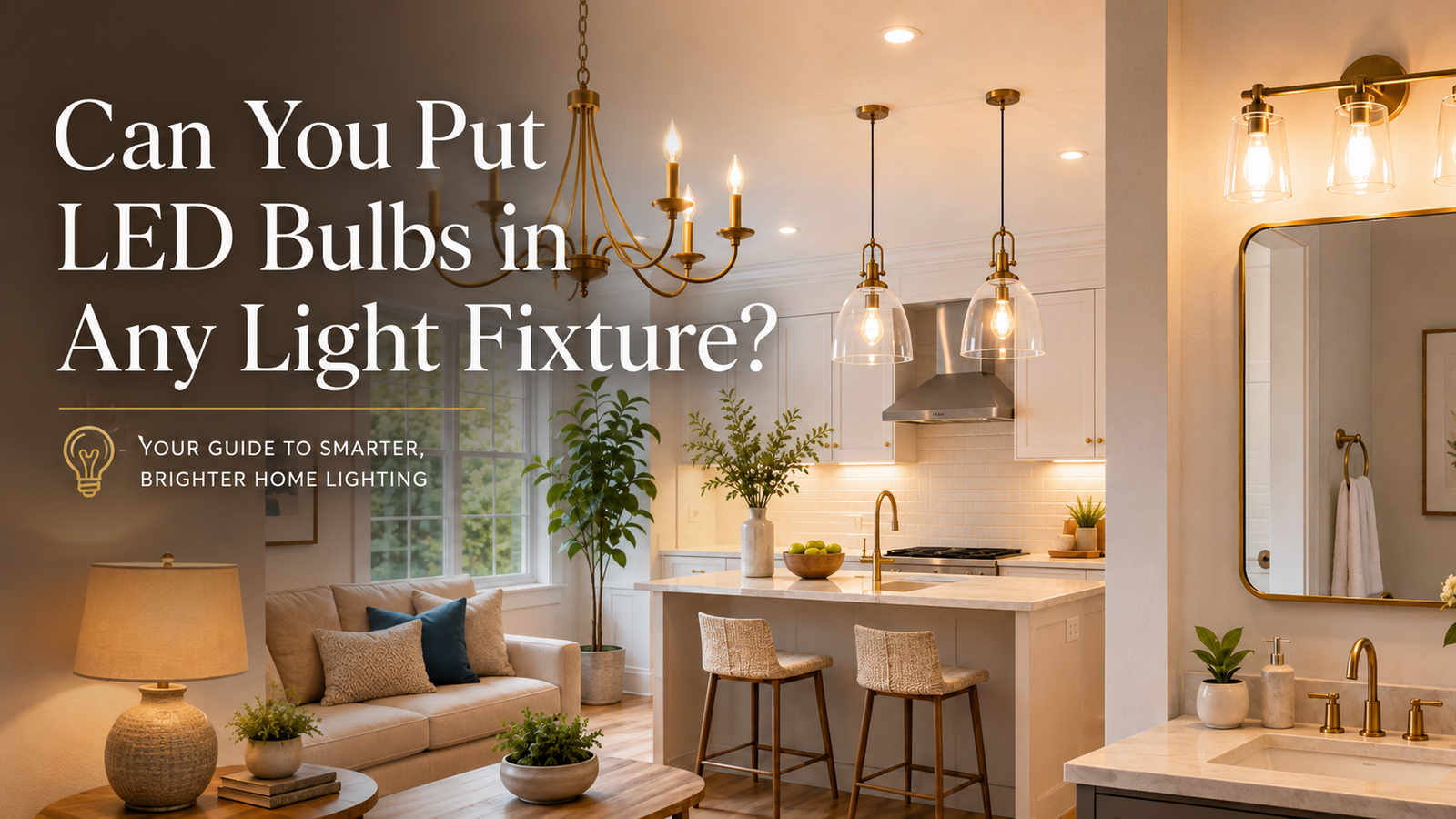

Can You Put LED Bulbs in Any Light Fixture?

LED bulbs have become one of the most popular choices for residential lighting because they use less energy, last longer, and are available in a wide variety of brightness levels and color temperatures.
But if your home has older light fixtures, you may wonder:
Can you put LED bulbs in any light fixture?
In many cases, yes. LED bulbs can replace traditional incandescent or halogen bulbs in most standard light fixtures. However, there are a few important factors to check before making the switch.
Check the Bulb Base
The first thing to consider is the bulb base.
Your LED bulb needs to use the same base type as the socket inside the fixture. Common residential bulb bases include:
- E26 medium base
- E12 candelabra base
- GU10
- GU24
- Bi-pin bases
For example, if your chandelier uses E12 candelabra bulbs, you will need LED bulbs with an E12 base.
Most standard pendants, vanity lights, and flush mounts use E26 medium-base sockets. Chandeliers and certain decorative fixtures often use the smaller E12 candelabra base instead. To illustrate, a fixture like the Vivio Milla 3-Light Vanity uses E26 sockets, while the Vivio Aura 5-Light Chandelier uses E12 - these are not interchangeable, even though both fixtures are from the same brand.
The physical shape of the bulb also matters. A large LED bulb may technically fit the socket but could be too wide or tall for the fixture's shade or glass.
Pay Attention to the Fixture's Wattage Rating

Every light fixture has a maximum wattage rating.
A fixture may say something such as:
Maximum 60W bulb
That does not necessarily mean you need a 60-watt LED bulb. It means the fixture is designed to safely handle up to that amount of electrical power.
LED bulbs are much more energy efficient than incandescent bulbs.
For example, an LED bulb using approximately 8 to 10 watts may produce a similar amount of light to a traditional 60-watt incandescent bulb. The Vivio ST19 LED Vintage Filament Bulb demonstrates this principle directly - it uses just 7 watts while producing 600 lumens, roughly equivalent to a 40-watt incandescent bulb.
When choosing LEDs, pay more attention to lumens, which measure light output, rather than trying to match the old bulb wattage exactly.
Can LED Bulbs Be Used in Enclosed Fixtures?

This is where you need to be more careful.
Some fixtures completely surround the bulb with glass or another material. These are known as enclosed fixtures.
LED bulbs create less heat than incandescent bulbs, but their internal electronics still generate heat. In an enclosed fixture, that heat can become trapped.
Excess heat may:
- Shorten the life of the LED bulb
- Cause flickering
- Reduce brightness
- Damage the bulb's internal electronics
Look for LED bulbs specifically labeled "suitable for enclosed fixtures" when installing them inside fully enclosed lights.
Can You Use LED Bulbs With a Dimmer?
Yes, but both the bulb and dimmer need to be compatible.
If your fixture is connected to a dimmer switch, choose an LED bulb labeled dimmable.
A non-dimmable LED used with a dimmer may flicker, buzz, behave unpredictably, or fail to dim properly.
Older dimmer switches were often designed for incandescent bulbs and may not work well with modern LEDs. In some cases, replacing the existing dimmer with an LED-compatible dimmer can provide smoother performance.
Can You Put LED Bulbs in Chandeliers?
Most chandeliers that use replaceable bulbs can use LEDs.
You simply need to match the correct:
- Bulb base
- Bulb shape
- Fixture dimensions
- Dimming requirements
LED candelabra bulbs are especially common in chandeliers because they provide the decorative appearance of traditional candle-style bulbs while consuming significantly less electricity.
For exposed-bulb chandeliers, consider the appearance of the bulb as well. Clear filament-style LED bulbs can provide a more traditional decorative look. The Vivio ST19 Vintage Filament Bulb uses an amber-tinted glass with visible filaments to replicate the look of a classic incandescent lamp, producing a warm 2200K glow. This type of bulb works particularly well in open-frame or exposed-socket fixtures like the Vivio Kaleesi 5-Light Pendant or other cage-style chandeliers where the bulb is visible.
What About Ceiling Fans?
Many ceiling fans can also use LED replacement bulbs.
However, ceiling fan light kits can have relatively compact or enclosed shades. Make sure the LED bulb physically fits inside the glass and is approved for the type of enclosure being used.
It is worth noting that many newer ceiling fans now ship with integrated LED light kits rather than replaceable bulb sockets. Most of Vivio Lighting's current ceiling fan line - including the 52-inch 3-Blade and 52-inch 5-Blade models - use built-in LED modules at 3000K. These fans do not accept separate replacement bulbs. If you want the flexibility to swap bulbs later, check the product specifications before purchasing.
Also check the fan manufacturer's specifications, especially if the ceiling fan uses a remote control or built-in dimming system.
What About Fixtures With Integrated LEDs?
Not every modern light fixture uses replaceable bulbs.
Many newer fixtures have integrated LED lighting, meaning the LEDs are built directly into the fixture.
These designs do not have a traditional socket, so you cannot simply install another LED bulb.
Integrated LED fixtures are commonly found in:
- Flush mounts
- LED chandeliers
- Ring pendants
- Vanity lights
- Low-profile ceiling lights
- Modern wall sconces
The Vivio Soffi LED Rectangle Vanity, for example, uses a 15W integrated LED source at 4000K rather than a replaceable bulb. The Vivio Elio 24-inch LED Halo Pendant uses a 35W integrated LED at 3000K. The Vivio 5/6-inch Low Profile LED Disk Light uses a 15W integrated LED with selectable color temperature.
When shopping for these fixtures, look at specifications such as lumens, wattage, color temperature, and dimming capability because you will not be selecting a separate bulb afterward.
Choose the Right LED Color Temperature

Switching to LEDs also gives you more control over how your room looks.
Common LED color temperatures include:
2700K: Warm, traditional light similar to incandescent bulbs.
3000K: Warm white that works well in living rooms, bedrooms, kitchens, and dining areas.
3500K: A more neutral appearance.
4000K: Crisp white light commonly used in bathrooms, kitchens, offices, and workspaces.
5000K: Bright daylight-like illumination often used in garages, utility spaces, and task-oriented areas.
The difference is noticeable in practice. The Vivio ST19 Vintage Filament Bulb at 2200K produces a distinctly amber, warm glow - well below even the 2700K standard warm white. The Vivio Soffi LED Vanity at 4000K produces a crisp, neutral appearance suited to grooming and task lighting. Vivio's selectable LED disk lights let you choose between 3000K, 4000K, and 5000K with a switch on the fixture, which is useful when you are not sure which temperature will work best in a particular room.
Choosing the right color temperature can make just as much difference as choosing the fixture itself.
Are LED Bulbs Better Than Incandescent Bulbs?
For most household applications, LEDs offer several advantages.
LED bulbs typically:
- Use significantly less electricity
- Last much longer
- Produce less heat
- Come in multiple color temperatures
- Are available in dimmable versions
- Offer many decorative shapes and styles
That makes them an easy upgrade for many chandeliers, pendants, ceiling fans, sconces, lamps, and ceiling fixtures.
Final Thoughts
So, can you put LED bulbs in any light fixture?
LED bulbs can be used in most fixtures that accept replaceable bulbs, but they are not automatically compatible with every installation.
Before installing one, check the bulb base, fixture wattage rating, available space, enclosure rating, and dimmer compatibility.
When everything matches, replacing traditional incandescent or halogen bulbs with LEDs can be a simple way to improve energy efficiency while giving you more control over the brightness and color of your home's lighting.
Browse Vivio Lighting's LED bulbs and LED fixtures for options across color temperatures and fixture types.