
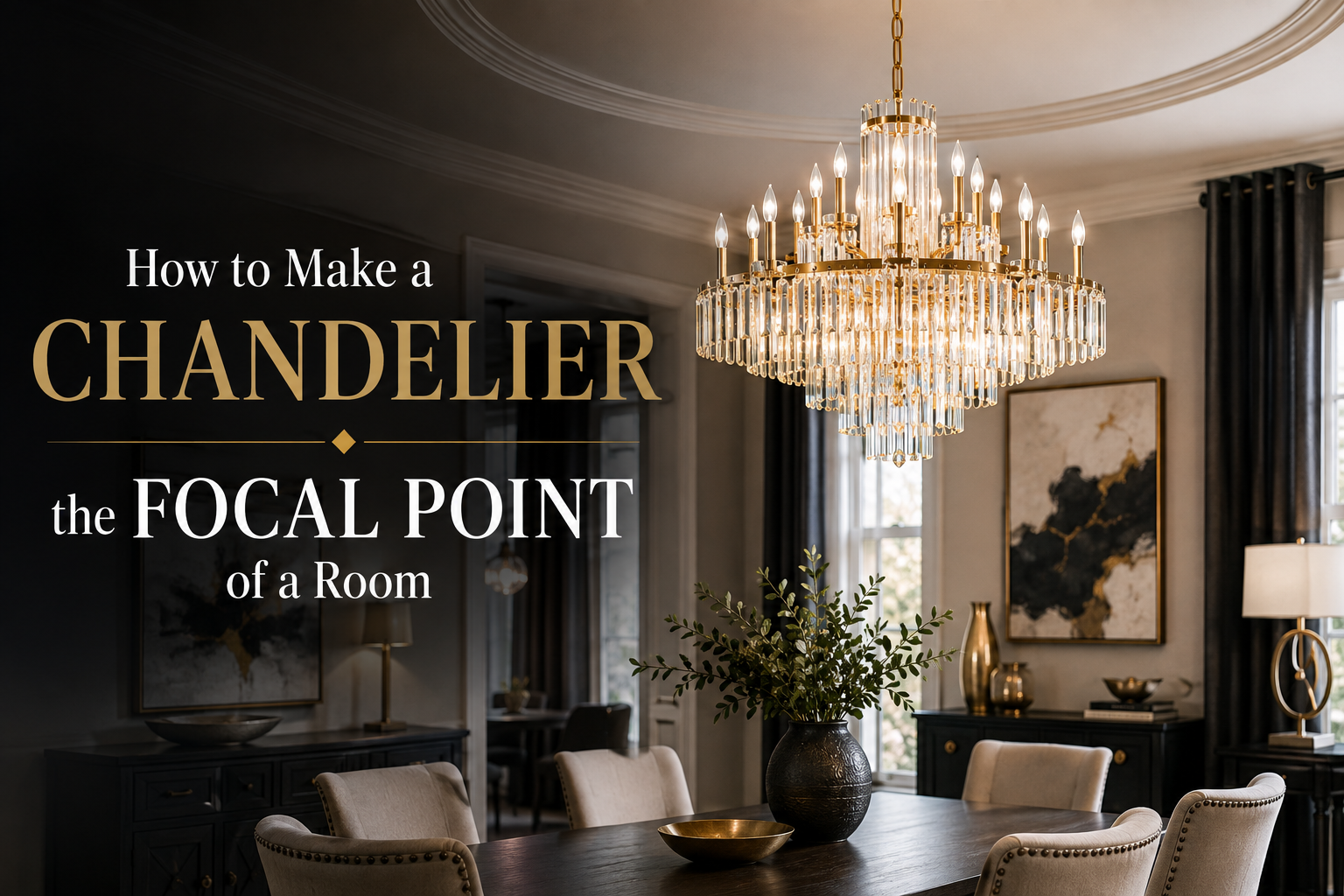

How to Make a Chandelier the Focal Point of a Room

A chandelier can do much more than illuminate a room. When chosen and positioned correctly, it can become the centerpiece that immediately attracts attention and helps define the entire space.
Whether installed above a dining table, in a living room, over a kitchen island, or inside a two-story foyer, the right chandelier can introduce scale, shape, texture, and personality to the room.
However, simply installing a decorative fixture does not automatically make it a focal point. Size, placement, surrounding furniture, lighting, and even the finishes around the chandelier all affect how noticeable it becomes.
This guide explains how to make a chandelier the focal point of a room while keeping the overall design balanced.
Choose a Chandelier With Visual Impact

The chandelier itself should have enough presence to attract attention without overwhelming the room.
Features that can make a chandelier stand out include:
- Large-scale proportions
- Sculptural shapes
- Multiple tiers
- Interesting glass elements
- Geometric frames
- Exposed decorative bulbs
- Contrasting finishes
- Ring or halo designs
- Sputnik-style arrangements
- Unique suspended elements
A simple room can often accommodate a more dramatic chandelier because there are fewer competing decorative elements. A fixture like the Odyssey 18-Light Sputnik Chandelier, with its radiating arms and matte gold finish, can command a minimally decorated room without any help from surrounding decor. In a busier space, the Amalfi LED Hex Chandelier - a geometric steel frame with frosted glass - provides presence through clean structure rather than complexity.
In rooms with patterned furniture, bold artwork, or detailed architectural features, a cleaner chandelier design may create better balance.
Make Sure the Chandelier Is Large Enough

One of the most common reasons a chandelier fails to become a focal point is that it is simply too small.
A fixture that looks substantial in a showroom or product photo may appear undersized once installed in a large room.
When choosing a chandelier, consider:
- Room width and length
- Ceiling height
- Furniture size
- Distance from surrounding walls
- Viewing distance
- Fixture height and width
For general room sizing, a common guideline is to add the room's length and width in feet and use the resulting number as an approximate chandelier diameter in inches.
For example:
A room measuring 12 feet by 14 feet may work well with a chandelier approximately 26 inches wide.
This is only a starting point. Open-concept rooms and spaces with high ceilings may require a larger fixture to create enough visual presence. The Alph 10-Light Chandelier, for instance, spans nearly 32 inches wide - a size that holds its own in a dining room or great room where a smaller fixture would disappear.
Position the Chandelier Where the Eye Naturally Travels

Placement has a major influence on whether a chandelier becomes the centerpiece of the room.
Rather than automatically centering the chandelier within the ceiling, consider what it should visually connect with below.
Common focal-point locations include:
- Above a dining table
- Over a kitchen island
- In the center of a foyer
- Above a living room seating arrangement
- Over a staircase
- Above a freestanding bathtub
- In the center of a bedroom
- Above a large entry table
A dining room chandelier, for example, should generally be centered over the dining table rather than centered within the entire room.
Connecting the fixture to an important piece of furniture makes the chandelier feel intentional.
Use the Right Hanging Height

A chandelier becomes easier to notice when it occupies the correct position within the room.
If it hangs too close to the ceiling, it may feel disconnected from the furniture below. If it hangs too low, it can interfere with sightlines and make the space feel crowded.
Above a dining table, chandeliers are commonly positioned approximately 30 to 36 inches above the tabletop when the room has an 8-foot ceiling.
For higher ceilings, additional hanging height may be appropriate. The Alph 6-Light Chandelier includes up to 10 feet of adjustable chain, which gives enough range to position the fixture correctly in rooms with standard or taller ceilings.
In foyers and open spaces, maintain enough clearance for people to comfortably walk below the chandelier.
Always consider the fixture's complete hanging height, including:
- Canopy
- Chain
- Cable
- Downrod
- Fixture body
- Shades
- Crystals
- Decorative elements
Create Contrast Around the Chandelier

Contrast naturally attracts attention.
A chandelier can stand out more when its finish contrasts with the surrounding surfaces.
For example:
- A matte black chandelier like the Laia 6-Light can stand out against a white ceiling.
- A brushed nickel fixture like the Elio LED Ring can provide contrast in a darker room.
- Clear glass can create visual interest against painted walls.
- A sculptural fixture can break up simple architectural lines.
- A round chandelier can soften a room dominated by rectangular furniture.
The goal is not necessarily to make the chandelier clash with the room. Instead, create enough difference that the fixture remains visually noticeable.
Keep the Surrounding Decor Simple

Too many statement pieces can compete for attention.
If the chandelier is intended to be the primary focal point, consider simplifying some of the surrounding elements.
This may include:
- Using understated artwork
- Limiting decorative accessories
- Choosing simple window treatments
- Reducing competing ceiling details
- Using neutral furniture
- Keeping nearby lighting fixtures more subtle
The chandelier should feel like the star of the room rather than one decorative feature among many equally dominant objects.
Coordinate the Chandelier With the Furniture Below

Creating a focal point does not mean the chandelier should feel disconnected from everything around it.
Repeating shapes, colors, or materials can visually connect the fixture to the rest of the room.
For example:
A round chandelier above a circular dining table creates a strong relationship between the fixture and furniture. The Aura 4-Light Strap Steel Sphere, with its globe silhouette and interchangeable candle covers in matte black, champagne gold, or brushed nickel, is built for that kind of pairing.
A linear chandelier can reinforce the shape of a rectangular dining table or kitchen island. The Roxton 8-Light Island stretches across the length of a counter or table, anchoring the zone beneath it.
A black chandelier can coordinate with black cabinet hardware, window frames, or furniture legs.
Small design connections help the chandelier feel intentional while still allowing it to attract attention.
Use Shape to Create Interest

Chandelier shape can significantly influence how dramatic the fixture appears.
Round Chandeliers
Round chandeliers create a centralized focal point and work especially well in:
- Foyers
- Round dining areas
- Bedrooms
- Living rooms
- Square spaces
Ring and Sputnik chandeliers are particularly effective when the fixture can be viewed from several directions. The Elio LED Ring Chandelier reads well from every angle in a room, while the Zara 6-Light Sputnik Sphere creates a starburst silhouette that looks equally dramatic whether viewed from straight on or below.
Linear Chandeliers
Linear chandeliers spread visual interest across a wider area and are ideal for:
- Rectangular dining tables
- Kitchen islands
- Long counters
- Pool tables
- Large desks
Their horizontal proportions can help define a specific zone within an open floor plan. The Roxton 8-Light Island Chandelier, with its matte black frame and wood-style accents, is designed specifically for this purpose - spanning a kitchen island or dining table while keeping the space around it open.
Multi-Tier Chandeliers
Multi-tier chandeliers create strong vertical impact and are particularly effective in:
- Two-story foyers
- Staircases
- Vaulted rooms
- Large entryways
Their height allows them to fill otherwise empty vertical space. The Roxton 8-Light Entry Chandelier, a rectangular open-cage design standing over 30 inches tall, was built for exactly these kinds of vertical rooms.
Use Ceiling Height to Your Advantage

High ceilings provide an opportunity to choose a chandelier with more dramatic proportions.
Instead of placing a small chandelier near the ceiling, consider using:
- Longer suspension cables
- Multiple tiers
- Tall chandelier frames
- Cascading elements
- Oversized rings
- Extended chains
A larger fixture helps visually connect the upper portion of the room with the furniture and architecture below.
In two-story spaces, also consider how the chandelier appears from the second floor.
Give the Chandelier Space Around It

Negative space can make a statement chandelier appear even more dramatic.
Avoid placing large decorative objects directly beside the fixture when possible.
The chandelier should have enough visual breathing room that its silhouette remains easy to see.
This is particularly important for chandeliers with:
- Open geometric frames
- Multiple arms
- Sputnik designs
- Sculptural shapes
- Layered rings
- Exposed bulbs
An uncluttered background allows the fixture's design to remain visible from across the room.
Use Layered Lighting

Making a chandelier the focal point does not mean it should provide every bit of light in the room.
Layered lighting usually creates a more comfortable and visually interesting space.
Combine the chandelier with fixtures such as:
- Recessed lighting
- Wall sconces
- Table lamps
- Floor lamps
- Under-cabinet lighting
- Accent lighting
Secondary fixtures can provide functional illumination while allowing the chandelier to remain the primary decorative feature.
Install a Dimmer

Brightness can dramatically change how a chandelier looks.
A dimmer allows the fixture to transition between functional lighting and softer ambient illumination.
Bright settings may work well during:
- Cleaning
- Entertaining
- Food preparation
- Family gatherings
Lower settings can create a more dramatic atmosphere for:
- Dinner
- Relaxing
- Evening entertaining
- Movie nights
Before installing a dimmer, confirm that the chandelier, bulbs, LED driver, and dimmer switch are compatible. Fixtures with integrated LEDs like the Elio LED Ring Chandelier are designed with dimming compatibility built in, removing one variable from the equation.
Choose the Right Bulbs

Bulbs are often part of the chandelier's appearance, particularly when they are visible through clear glass or completely exposed.
Consider:
- Bulb shape
- Color temperature
- Brightness
- Filament style
- Frosted versus clear glass
- Dimming compatibility
Decorative bulbs can reinforce the chandelier's style while helping the entire fixture look more intentional.
For comfortable residential lighting, warm white light around 2700K to 3000K is commonly used in dining rooms, bedrooms, and living spaces.
Highlight Architectural Features

A chandelier can become even more dramatic when it works with the architecture of the room.
Consider positioning or selecting the fixture around features such as:
- Vaulted ceilings
- Ceiling beams
- Tray ceilings
- Large windows
- Staircases
- Arched entryways
- Two-story ceilings
The chandelier can visually emphasize these architectural elements while becoming part of the overall composition.
Consider How the Chandelier Looks From Other Rooms

In open-concept homes, a chandelier may be visible from several locations.
Before selecting a fixture, consider how it will appear from:
- The kitchen
- Living room
- Hallway
- Entryway
- Staircase
- Second floor
- Exterior windows
A chandelier with an attractive profile from multiple angles will usually create a stronger focal point.
This is particularly important for open-frame, ring, globe, and Sputnik-style fixtures.
Avoid Too Many Competing Fixtures

Open floor plans sometimes contain multiple chandeliers, pendants, ceiling fans, and decorative fixtures within the same sightline.
When every fixture is highly decorative, the room can begin to feel visually busy.
If one chandelier is intended to be the focal point, keep nearby fixtures simpler.
For example, a dramatic dining chandelier might be paired with understated kitchen pendants and recessed lighting.
This creates a clear visual hierarchy.
Match the Chandelier to the Room's Style

A chandelier should attract attention while still belonging in the space.
Modern Rooms
Consider:
- Integrated LED designs
- Geometric frames
- Ring chandeliers
- Matte black finishes
- Brushed metal
- Minimalist forms
The Amalfi LED Hex Chandelier and the Ava LED Double Ring Chandelier both fit this category - geometric, LED-integrated, and clean enough to anchor a modern space without competing with it.
Traditional Rooms
Consider:
- Candle-style chandeliers
- Multi-arm fixtures
- Tiered designs
- Crystal elements
- Decorative frames
The Alph 10-Light Chandelier works well in these rooms. Its ten candle-style arms and rotatable design give it the multi-arm presence a traditional room calls for, while the matte black, matte gold, or brushed nickel finish options keep it from feeling dated.
Industrial Rooms
Consider:
- Exposed bulbs
- Black metal
- Open cages
- Mixed wood and metal finishes
The Laia 6-Light Chandelier is a natural fit here - its open-air design and adjustable wires showcase exposed edison-style bulbs as part of the fixture's look rather than hiding them. The Roxton 8-Light Entry, with its open cage construction and combined wood and matte black finish, bridges industrial and farmhouse styles.
Transitional Rooms
Consider combining traditional chandelier proportions with cleaner contemporary finishes and simplified detailing. The Aura 5-Light Chandelier does exactly this - a candle-style fixture with classic proportions, finished in a two-toned matte black and brushed nickel that reads as contemporary without abandoning the traditional form.
Common Mistakes When Creating a Chandelier Focal Point

Avoid these common design mistakes:
- Choosing a chandelier that is too small
- Hanging the fixture too close to the ceiling
- Hanging it too low
- Centering it in the room instead of over the furniture
- Choosing several competing statement fixtures
- Ignoring the view from adjacent rooms
- Selecting bulbs that create excessive glare
- Using a chandelier that does not complement the room's proportions
- Ignoring ceiling height
- Choosing style without considering light output
- Installing the chandelier without adequate ceiling support
Taking measurements and considering the chandelier from several viewing angles before installation can prevent many of these problems.
Final Thoughts
A chandelier becomes a true focal point when its size, shape, placement, and lighting work together.
Choose a fixture with enough visual presence for the room, position it where the eye naturally travels, and allow enough space around it for the design to stand out. Coordinating the chandelier with nearby furniture and finishes can keep the space cohesive without reducing its impact.
Whether you prefer a dramatic Sputnik design like the Odyssey or Zara, a minimalist LED ring like the Elio or Ava, a traditional candle-style design like the Alph, or a long linear fixture like the Roxton Island, the right chandelier can transform an ordinary room into a more polished and memorable space.
Explore Vivio Lighting chandeliers to find a fixture that can bring light, character, and a strong focal point to your home.