
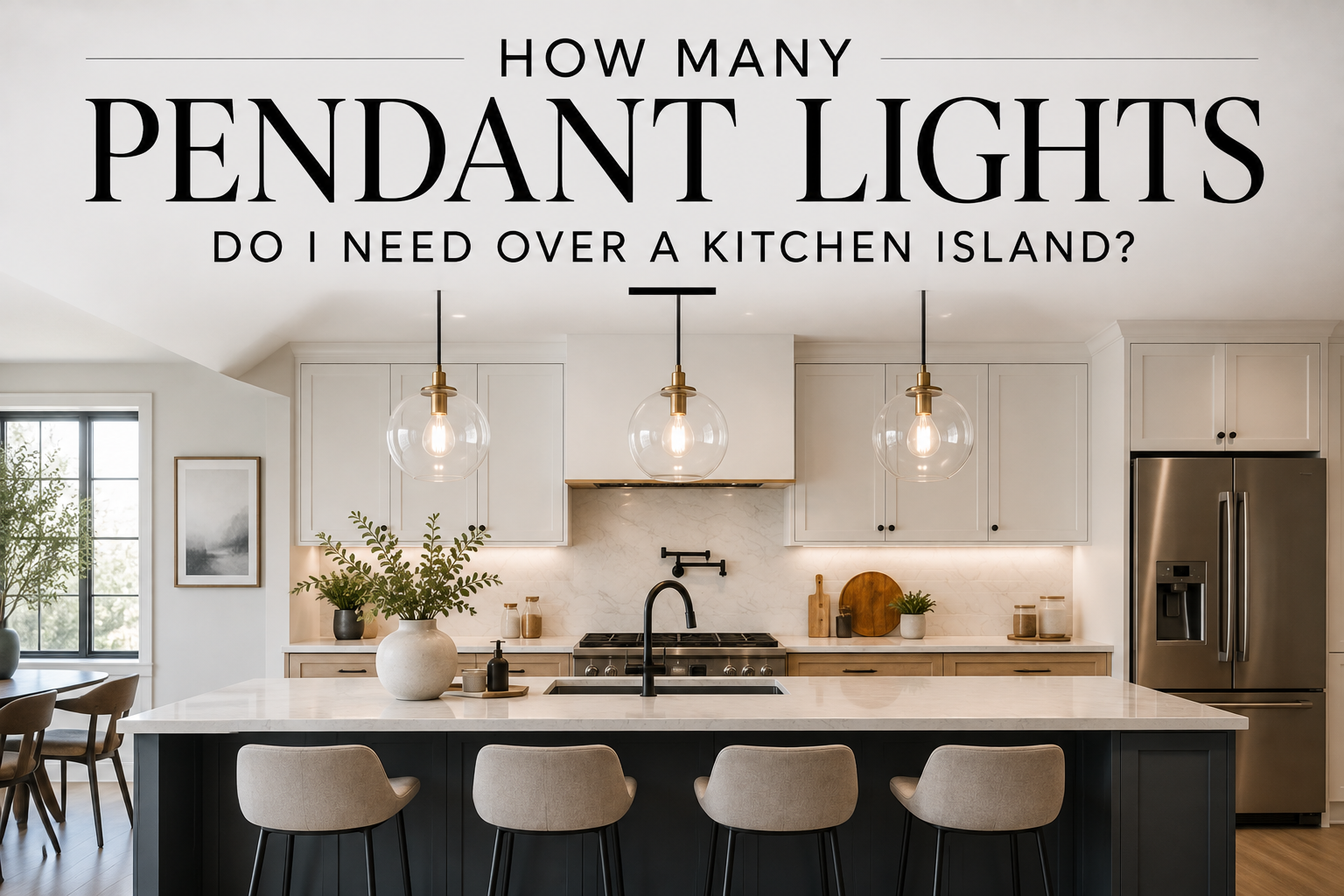

How Many Pendant Lights Do I Need Over a Kitchen Island?

Pendant lights are one of the most popular ways to illuminate a kitchen island. They provide task lighting for cooking and food preparation while also helping define the island as a focal point within the room.
But deciding how many pendant lights to install can be surprisingly difficult.
Should a six-foot island have two pendants or three? How far apart should they be? And what happens if the pendants are unusually large?
There is no single number that works for every kitchen. The right number of pendant lights depends on the length of the island, the size of the fixtures, ceiling height, and how much light the space needs.
This guide explains how to determine the right number of pendant lights for your kitchen island.
How Many Pendants Should Go Over a Kitchen Island?

Most kitchen islands use two or three pendant lights, but larger islands may accommodate four or more.
As a general starting point:
| Kitchen Island Length | Typical Number of Pendants |
|---|---|
| 4-5 feet | 1-2 |
| 6 feet | 2-3 |
| 7-8 feet | 2-3 |
| 9-10 feet | 3-4 |
| 10+ feet | 3-5 |
These numbers are guidelines rather than strict rules.
A kitchen with two oversized pendants may look more balanced than one with three small pendants, even when the islands are the same length.
The goal is to create even lighting without making the island look crowded.
Start With the Length of the Kitchen Island

Island length is one of the most important factors when choosing the number of pendant lights.
Small Kitchen Islands
For islands around four to five feet long, one large pendant or two smaller pendants may provide enough visual balance and illumination.
Using too many fixtures over a short island can make the area feel cluttered.
A single decorative pendant - like the Alix 1-Light Metal Shade Pendant - can also create a stronger focal point in a compact kitchen.
Medium Kitchen Islands
Six- to eight-foot islands commonly work well with two or three pendant lights.
Two larger fixtures can create a clean, open appearance.
Three smaller fixtures can provide more even light distribution across the countertop. Glass cylinder pendants like the Soffi work well grouped in twos or threes over a medium island.
The better option depends largely on the diameter of the pendants.
Large Kitchen Islands
Islands measuring nine feet or longer may require three or four pendant lights, particularly when using smaller fixtures.
Large kitchens can also accommodate oversized pendants spaced farther apart.
Rather than automatically adding more fixtures, consider whether fewer large pendants would create a cleaner design. A single linear fixture like the Soffi Linear 5-Light can illuminate a long island from one canopy, keeping the ceiling clean and the sightlines open.
Consider the Diameter of the Pendants

The size of each pendant can be just as important as the length of the island.
For example, three 12-inch pendants require significantly less space than three 24-inch pendants.
Larger fixtures generally need:
- More space between each pendant
- More visual breathing room
- Fewer fixtures overall
Smaller pendants can typically be placed closer together and may require additional fixtures to provide balanced lighting.
Before choosing the number of pendants, check the complete dimensions of the fixture rather than relying only on product photos.
How Far Apart Should Kitchen Island Pendants Be?

A common starting point is to leave approximately 24 to 30 inches between the centers of neighboring pendant lights.
However, spacing should be adjusted according to fixture size.
Large pendants usually need more separation, while smaller fixtures can often be positioned closer together.
The layout should look evenly distributed across the island rather than crowded toward the center.
For example, three pendants above a long island should normally appear evenly spaced instead of having large gaps near the ends.
Leave Space at Each End of the Island
Pendant lights generally should not sit directly over the outer edges of the countertop.
Leaving approximately 12 to 18 inches between the ends of the island and the center of the nearest pendant can help create a balanced appearance.
Larger fixtures may require additional clearance.
This also prevents the outer pendants from appearing disconnected from the rest of the island.
Two Pendants vs. Three Pendants

One of the most common decisions homeowners face is whether to install two or three pendant lights.
Choose Two Pendants When:
- The pendants are relatively large
- The island is approximately five to eight feet long
- You want a clean, minimalist appearance
- The fixtures have strong visual presence
- The kitchen has other decorative lighting nearby
Two oversized pendants can often create more impact than several smaller fixtures. Open cage designs like the Vega or Gomez geometric pendants carry enough presence as a pair that a third fixture would crowd the arrangement.
Choose Three Pendants When:
- The pendants are relatively small
- The island is six feet or longer
- You want more even light distribution
- The design benefits from symmetry
- The island is the main focal point of the kitchen
Three pendants create a natural rhythm and work particularly well with simple fixture designs.
Can You Use One Large Pendant Over an Island?

Yes.
A single oversized pendant can work particularly well above a smaller kitchen island or square island.
Large decorative fixtures can create a dramatic centerpiece while keeping the ceiling visually clean.
One fixture may also be appropriate when the kitchen already includes several other lighting elements, such as:
- Recessed lighting
- Under-cabinet lighting
- Dining chandeliers
- Track lighting
- Ceiling fixtures
The pendant does not necessarily need to provide all of the kitchen's illumination by itself.
How High Should Pendant Lights Hang?

Pendant lights are commonly installed approximately 30 to 36 inches above the kitchen island countertop.
This provides enough separation for comfortable sightlines while keeping the light close enough to illuminate the work surface.
Higher ceilings may allow the pendants to hang slightly higher depending on the size and style of the fixture.
Before installation, consider whether the pendants could interfere with:
- Conversations across the island
- Views into adjoining rooms
- Tall appliances
- Cabinet doors
- Seating areas
The bottom of the pendant should generally remain above normal eye level when someone is standing near the island.
Consider Ceiling Height

Ceiling height can change how pendant lighting looks within the kitchen.
8-Foot Ceilings
Compact pendants and shorter suspension lengths usually work best.
Fixtures that are too tall may make the kitchen feel crowded.
9- to 10-Foot Ceilings
These ceilings can accommodate larger pendants and longer suspension rods or cords.
They also provide more flexibility when adjusting hanging height.
Vaulted or High Ceilings
Large pendants can help fill vertical space and visually connect the ceiling with the island below.
Always check whether the pendant is compatible with sloped ceilings if the island is located beneath a vaulted ceiling.
Think About Light Output, Not Just Fixture Count

More pendant lights do not automatically mean better kitchen lighting.
Light output depends on:
- Number of bulbs
- Bulb wattage
- LED lumen output
- Shade material
- Shade direction
- Fixture height
- Other lighting in the room
Three decorative pendants with low-output bulbs may provide less usable light than two high-output fixtures.
Pendant lighting should normally work as part of a layered lighting plan that may include recessed lights, under-cabinet lights, and other ceiling fixtures.
Choose the Right Pendant Shape
Fixture shape can influence how many pendants look appropriate over the island.
Globe Pendants
Globe pendants provide a balanced appearance from several viewing angles and work well in open-concept kitchens.
Because globes can have a strong visual presence, larger designs may require fewer fixtures. The Pixi 3-Light Illuminated Glass Cube Pendant is a good example - its glass form reads as a complete piece on its own, so one or two units can handle a medium island.
Cylinder Pendants
Tall, narrow cylinders take up less horizontal space and can work well in groups of three or more.
They are particularly useful when you want multiple light sources without making the ceiling feel crowded.
Dome Pendants
Wide dome-style pendants direct attention toward the island surface and often look best when used in pairs.
Because of their width, adequate spacing is especially important.
Linear Pendants
Instead of installing several individual pendants, one long linear fixture can sometimes illuminate the entire island.
This can create a cleaner appearance in contemporary or minimalist kitchens.
Should Pendant Lights Be Odd or Even?

There is no rule requiring pendant lights to be installed in odd numbers.
Three pendants can create a symmetrical arrangement with one fixture centered over the island.
Two pendants can create equally strong symmetry when they are evenly spaced on either side of the island's center.
The size and proportions of the fixtures matter more than whether the number is odd or even.
Center the Pendants Over the Island, Not the Room

One common installation mistake is centering pendant lights according to the dimensions of the kitchen rather than the island.
Pendant lighting should usually align with the countertop below.
If the kitchen island is not centered within the room, the pendants may also appear slightly off-center relative to the ceiling.
That is typically preferable because the lighting will still feel visually connected to the island.
Consider the View From Adjacent Rooms

Kitchen islands are frequently visible from dining rooms, living rooms, and entryways.
Before choosing pendant lights, consider how the fixtures will look from different directions.
Open-concept kitchens particularly benefit from pendants with attractive profiles on every side.
Also consider nearby decorative fixtures.
If a large chandelier is visible above the dining table, simpler kitchen pendants may help prevent the two lighting features from competing for attention.
Common Kitchen Island Pendant Lighting Mistakes
Avoid these common mistakes when planning your pendant layout:
- Installing too many pendants
- Choosing fixtures that are too small
- Choosing fixtures that overwhelm the island
- Placing pendants too close together
- Positioning fixtures too close to the ends of the island
- Hanging pendants too low
- Hanging pendants too high
- Centering fixtures in the room instead of over the island
- Ignoring ceiling height
- Ignoring views from neighboring rooms
- Choosing style without considering light output
- Failing to check whether fixtures are dimmable
- Forgetting to account for seating and sightlines
Measuring the island and reviewing the complete fixture dimensions before installation can prevent most of these problems.
How to Calculate the Best Pendant Layout

Before purchasing your fixtures, measure:
- The total length of the island
- The width of the island
- The diameter or width of each pendant
- The ceiling height
- The desired hanging height
Then determine how much space the fixtures will occupy.
For example, an eight-foot island may look balanced with three small pendants or two oversized pendants.
Rather than choosing the number of fixtures first, choose a pendant style you like and then determine how many will fit comfortably over the island.
Final Thoughts: How Many Pendant Lights Do You Need?
For most kitchen islands, two or three pendant lights provide the best balance between illumination and visual appeal.
Smaller islands may only need one or two fixtures, while large islands may require three or four.
Consider the island's length, pendant diameter, ceiling height, spacing, and overall kitchen design before making your decision.
Above all, avoid overcrowding the space. Pendant lights should complement the proportions of the kitchen island while providing comfortable illumination for cooking, dining, and everyday activities.
Choosing the right combination of size and spacing can turn your kitchen island lighting into one of the defining features of the room.
Browse Vivio Lighting's full pendant collection to find the right fixtures for your kitchen island.