
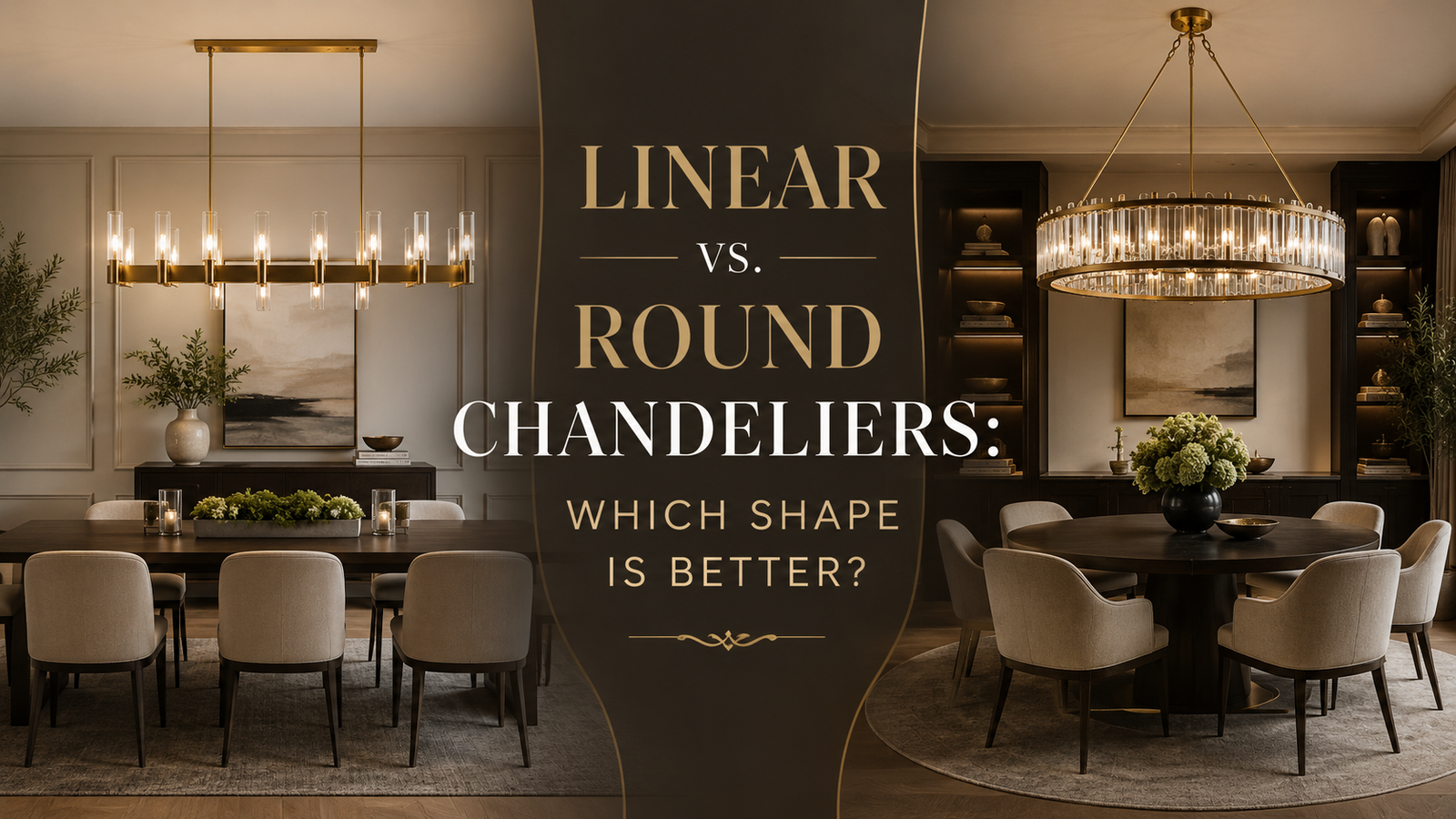

Linear vs. Round Chandeliers: Which Shape Is Better?

Choosing a chandelier involves more than selecting a finish or style. The shape of the fixture can affect how the room feels, how evenly the light is distributed, and how well the chandelier relates to the furniture below it.
Linear chandeliers extend horizontally and are commonly installed above rectangular dining tables, kitchen islands, and long seating areas. Round chandeliers create a centralized focal point and work well above circular tables, square tables, entryways, and open rooms.
Neither shape is automatically better. The best choice depends on the room's layout, furniture proportions, ceiling height, and lighting needs.
This guide compares linear and round chandeliers to help you choose the right shape for your space.
What Is a Linear Chandelier?

A linear chandelier is a horizontally oriented light fixture designed to spread illumination across a long surface.
Linear chandeliers may feature:
- A single horizontal frame
- Multiple lights arranged in a row
- Rectangular or geometric structures
- Suspended glass shades
- Integrated LED bars
- Several pendants attached to one canopy
Because of their elongated shape, linear chandeliers are commonly used above rectangular dining tables and kitchen islands. The Vivio Kosi 10-Light Candelabra Island Pendant is one example - its ten candle lights are arranged along a horizontal frame, making it a natural fit above long surfaces. For a farmhouse or rustic-leaning kitchen, the Vivio Roxton 8-Light Island pairs a matte black frame with wood-style accents and clear glass shades across a wide span.
They can also work well above pool tables, conference tables, long desks, and seating areas.
What Is a Round Chandelier?

A round chandelier is built around a circular, spherical, or centralized frame.
Common round chandelier designs include:
- Ring chandeliers
- Globe chandeliers
- Drum chandeliers
- Sputnik chandeliers
- Tiered chandeliers
- Circular candle-style fixtures
- Crystal chandeliers
- Round integrated LED pendants
Round fixtures create a balanced appearance from multiple viewing angles. Vivio Lighting's collection includes several variations on this shape - from the Odyssey 18-Light Sputnik Sphere Chandelier with its mid-century starburst silhouette, to the Elio 24" LED Halo Ring Pendant in brushed nickel, to the Alph 10-Light Flat Bottom Chandelier with its rotatable candle-style arms.
Round chandeliers are often used above round dining tables, in entryways, bedrooms, living rooms, and other spaces where the light should remain centered.
Linear vs. Round Chandeliers at a Glance

| Feature | Linear Chandelier | Round Chandelier |
|---|---|---|
| Overall shape | Long and horizontal | Circular or centralized |
| Best table shape | Rectangular or oval | Round or square |
| Common locations | Dining tables, islands, desks | Foyers, round tables, bedrooms |
| Light distribution | Spreads light across a long area | Directs light around a central point |
| Visual effect | Makes the room feel longer | Creates symmetry and balance |
| Installation focus | Alignment with furniture | Centering within the space |
| Best for open layouts | Helps define a specific zone | Creates a central focal point |
Choose a Chandelier That Matches the Table Shape

The shape of the dining table or kitchen island is usually the most important consideration.
Rectangular Tables
Linear chandeliers are often the best choice above rectangular dining tables because their proportions follow the length of the table.
A long fixture helps distribute light across the entire dining surface rather than concentrating it in the center. The Kosi 10-Light Candelabra Island Pendant, available in both matte black and champagne gold, is designed specifically for this kind of placement - its ten lights spread evenly across the frame to cover the full length of a dining table or island.
Round chandeliers can still work above rectangular tables, especially when the fixture is large enough to create a strong visual presence. However, a small round chandelier may leave the ends of a long table feeling visually disconnected or less illuminated.
Round Tables
Round chandeliers naturally complement round dining tables.
Repeating the circular shape creates a balanced connection between the fixture and the furniture below it. Globe, ring, drum, and tiered chandeliers can all work well in this setting. The Aura 4-Light Strap Steel Sphere is one option - its 18-inch globe frame echoes the curve of a round table while the candle covers are available in matte black, champagne gold, and brushed nickel to match the room's hardware.
A linear chandelier may look awkward above a small round table because its width can extend too far beyond the table's edges.
Square Tables
Square dining tables can work with either shape.
A round chandelier can soften the straight lines of the table and create a centered focal point. A compact linear or square chandelier can reinforce the table's geometric appearance.
Whichever shape you choose, the fixture should look balanced from every side.
Oval Tables
Oval tables offer more flexibility.
A linear chandelier can emphasize the length of the table, while a round or oval chandelier can complement its curved edges.
The best choice will depend on the table's overall length and the amount of visual space available above it.
Consider How the Fixture Distributes Light

Chandelier shape can influence where the light is directed.
Linear Light Distribution
Linear chandeliers spread light horizontally. This makes them useful above surfaces where people sit or work across a wide area.
They are especially effective above:
- Long dining tables
- Kitchen islands
- Breakfast bars
- Pool tables
- Conference tables
- Large desks
Fixtures with multiple bulbs or shades arranged in a row can provide more consistent illumination from one end of the surface to the other. The Vivio Soffi 5-Light Illuminated Glass Cylinder Pendant uses five integrated LED glass cylinders spaced across a chrome bar, giving it a clean spread of light without exposed bulbs. The Pixi 5-Light Illuminated Glass Cube Pendant achieves a similar layout with a matte black finish and cube-shaped glass instead.
Round Light Distribution
Round chandeliers distribute light around a central location.
They work well when the room or furniture arrangement is organized around one point, such as:
- A round dining table
- A foyer
- A central seating area
- A staircase
- A bedroom
- A breakfast nook
Ring-style LED fixtures like the Vivio Elio and the AVA Single Ring Pendant cast light both downward and outward from the ring itself, creating an even glow around the fixture's perimeter. Multi-arm designs like the Odyssey 18-Light Sputnik direct light outward in every direction from a central hub.
The number of bulbs, shade material, fixture height, and bulb brightness will also affect the final light output.
Think About the Size of the Room

The chandelier should be proportionate to both the furniture and the room.
A narrow linear chandelier can make a long dining room or kitchen feel more balanced. It reinforces the direction of the room and helps visually connect the space.
A round chandelier can help fill a square room or open foyer without emphasizing one direction more than another.
In larger spaces, an undersized chandelier may appear lost. A wider linear fixture, oversized round chandelier, or multi-tier design may provide a stronger presence.
Before purchasing, review the fixture's complete dimensions, including:
- Width
- Length
- Height
- Canopy size
- Chain or downrod length
- Shades
- Crystals
- Decorative extensions
Use painter's tape or a cardboard outline to visualize the chandelier's dimensions before installation.
Match the Chandelier to the Room Layout

Furniture placement can help determine whether a linear or round shape will look more intentional.
Open-Concept Rooms
A linear chandelier can help define a dining area within an open floor plan. Its horizontal shape creates a clear visual boundary above the table or island. The Roxton 8-Light Island, for example, uses its wide wooden frame and eight clear glass shades to mark out the kitchen island as a distinct zone within a larger open space.
A round chandelier can also define a zone, but it usually creates a more centralized focal point.
Narrow Rooms
Linear chandeliers often work well in narrow dining rooms because they follow the direction of the space.
Make sure the fixture is not so wide that it makes the room feel crowded.
Square Rooms
Round chandeliers are a natural choice for square rooms because they create balance without visually stretching the room in one direction.
They can also soften rooms with many straight architectural lines.
Large Entryways
Round, globe, tiered, and cascading chandeliers are often effective in entryways because they can be viewed from several directions. The Alph 10-Light Flat Bottom Chandelier works well in this kind of space - its 31.75-inch width and rotatable arms give it presence from every angle, and it is available in matte black, matte gold, and brushed nickel. For a smaller entryway, the Alph 6-Light offers the same design in a more compact size.
A linear fixture may work in a long hallway or rectangular foyer, but it should align carefully with the architecture.
Consider the Viewing Angles

A chandelier may be visible from several areas of the home.
Round chandeliers are generally symmetrical, so they tend to look balanced from every side. This makes them useful in open foyers, stairwells, and rooms where people regularly walk around the fixture.
Linear chandeliers often have a more dramatic front and side profile. A fixture that looks substantial from the front may appear much narrower when viewed from the end.
Before choosing a linear chandelier, consider how it will look from:
- The room entrance
- Adjacent living spaces
- The kitchen
- The staircase
- Exterior windows
- Different seats around the table
A fixture should complement the room from the angles that will be seen most often.
Compare Installation Requirements

Both linear and round chandeliers require careful placement, but linear fixtures may require additional alignment.
Installing a Linear Chandelier
A linear chandelier should generally be centered over the table or island and aligned with its length.
Some fixtures use two mounting points or a large rectangular canopy. Accurate measurements are important because even a small alignment issue may be noticeable.
Verify that the electrical box and ceiling structure can support the fixture.
Installing a Round Chandelier
A round chandelier is typically installed from one central mounting point.
The main challenge is making sure the fixture is properly centered over the table, furniture grouping, or room feature below it.
Oversized and multi-tier round chandeliers may still require additional structural support.
Professional installation is recommended for large, heavy, crystal, multi-tier, or integrated LED fixtures.
Account for Ceiling Height

Ceiling height affects the chandelier's size and suspension style.
For standard-height dining rooms, both linear and round chandeliers can work well as long as they maintain comfortable clearance above the table.
Rooms with higher ceilings can accommodate:
- Taller chandelier frames
- Multiple tiers
- Longer downrods
- Extended chains
- Cascading designs
- Larger decorative elements
In a two-story foyer, a large round or multi-tier chandelier often creates a stronger focal point because it fills vertical space.
In a long vaulted room, a suspended linear chandelier can emphasize the architecture while distributing light across a larger area.
Always confirm that the chandelier includes enough chain, cable, or downrod length for the ceiling height.
Match the Fixture to the Interior Style

Both chandelier shapes are available in a wide variety of styles.
Linear Chandeliers Often Suit
- Modern interiors
- Industrial spaces
- Farmhouse dining rooms
- Contemporary kitchens
- Minimalist homes
- Transitional spaces
- Mid-century-inspired rooms
Linear chandeliers with black frames, clear glass shades, or integrated LED elements can create a clean architectural appearance. The Pixi 5-Light fits modern and minimalist rooms with its matte black finish and illuminated glass cubes. The Roxton 8-Light Island leans farmhouse with its wood-style accents. The Kosi 10-Light in Champagne Gold brings a transitional warmth with its candelabra arms and metallic finish.
Round Chandeliers Often Suit
- Traditional interiors
- Formal dining rooms
- Transitional spaces
- Glamorous interiors
- Contemporary rooms
- Minimalist designs
- Grand entryways
Ring chandeliers, crystal fixtures, and globe designs can range from understated to highly decorative. The Odyssey 18-Light Sputnik brings mid-century character in brushed brass or matte black. The Elio LED Halo Ring reads as contemporary and minimal. The Elza 6-Light Cage Pendant adds an industrial edge with its mesh drum shade, while the Aura 5-Light Clear Glass Chandelier bridges farmhouse and transitional with its clean lines and glass shades.
The shape should support the room's proportions, while the finish and details should coordinate with the overall style.
Consider Maintenance and Bulb Access

Chandelier shape can affect how easy the fixture is to clean and maintain.
Linear chandeliers may have multiple shades, bulbs, or glass panels spread across a wide frame. Reaching the bulbs at each end may be difficult if the fixture is installed above a large table or island.
Round chandeliers may include several layers of crystals, rings, or exposed bulbs that require regular dusting.
Before choosing a fixture, consider:
- How easily the bulbs can be reached
- Whether glass shades can be removed
- How often the fixture may need cleaning
- Whether replacement parts are available
- Whether the LED light source is integrated
- Whether the chandelier can be lowered for service
Fixtures installed on high or vaulted ceilings may require professional maintenance. Integrated LED fixtures like the Elio and Soffi reduce bulb replacement needs but should be evaluated for long-term serviceability before purchase.
When Is a Linear Chandelier Better?

A linear chandelier may be the better choice when:
- The dining table is long and rectangular
- The fixture will be installed above a kitchen island
- You need light distributed across a wide surface
- The room has a narrow or elongated layout
- You want to define a dining zone in an open floor plan
- The interior style is modern, industrial, or minimalist
- The architecture includes strong horizontal lines
Linear chandeliers are especially effective when the fixture needs to relate directly to a long piece of furniture. The Kosi 10-Light and Roxton 8-Light Island are both designed with this in mind - their widths are scaled to match standard island and dining table lengths.
When Is a Round Chandelier Better?

A round chandelier may be the better choice when:
- The dining table is round or square
- The fixture will be viewed from several directions
- You want a centralized focal point
- The room has a square layout
- The chandelier will be installed in a foyer
- You want to soften straight architectural lines
- The room needs a symmetrical appearance
- The space has a high or two-story ceiling
Round fixtures are versatile and can work in both compact and oversized spaces. The Sputnik 6-Light fits smaller rooms with its 14-inch frame, while the Odyssey 18-Light at nearly 29 inches wide can anchor a larger dining room or entryway.
Can You Use Two Round Chandeliers Instead of One Linear Fixture?

Two smaller round chandeliers can sometimes replace one long linear chandelier.
This approach may work above:
- Extra-long dining tables
- Large kitchen islands
- Double islands
- Long commercial counters
- Large open seating areas
Using two fixtures can create rhythm and improve light distribution. However, the chandeliers must be spaced evenly and aligned with the furniture below. A pair of Vivio Roxton 1-Light Pendants spaced above a kitchen island is one way to achieve this effect while keeping each fixture simple.
The electrical layout and ceiling structure should also be evaluated before installation.
Common Chandelier Shape Mistakes
Avoid these common mistakes when comparing linear and round chandeliers:
- Choosing a fixture that does not relate to the table shape
- Selecting a chandelier that is too small
- Allowing a linear fixture to extend beyond the table
- Using a small round chandelier above an extra-long table
- Centering the chandelier in the room instead of over the furniture
- Ignoring the fixture's side profile
- Failing to consider the view from adjacent rooms
- Choosing style over light distribution
- Overlooking ceiling support requirements
- Forgetting to check the total hanging height
Taking detailed measurements before purchasing can prevent most sizing and placement problems.
Linear vs. Round Chandeliers: Which One Should You Choose?

Choose a linear chandelier when you want the fixture to follow the length of a rectangular table, kitchen island, or narrow room. Its horizontal shape can provide balanced illumination and reinforce the proportions of the furniture below it.
Choose a round chandelier when you want a centralized focal point, balanced viewing angles, or a fixture that complements a round or square table. Round chandeliers are also a strong option for foyers, staircases, bedrooms, and high-ceiling spaces.
The best chandelier shape is the one that feels connected to the room's architecture and furniture while providing the right amount of light.
Frequently Asked Questions
Should a chandelier match the shape of the dining table?
It does not have to match exactly, but coordinating the shapes often creates a more balanced appearance. Linear chandeliers usually work best with rectangular tables, while round chandeliers naturally complement round and square tables.
Can a round chandelier go over a rectangular table?
Yes. A large round chandelier can create a strong focal point above a rectangular table. Make sure it is wide enough to feel proportionate and provides sufficient light toward the ends of the table.
Can a linear chandelier go over a round table?
It is possible, but the fixture should be compact enough that it does not extend far beyond the table. A round or symmetrical chandelier will usually create a more natural relationship.
Are linear chandeliers only for kitchen islands?
No. Linear chandeliers can also be used above dining tables, pool tables, desks, conference tables, and long seating arrangements.
Are round chandeliers better for high ceilings?
Round, globe, and multi-tier chandeliers often work well with high ceilings because they can fill both horizontal and vertical space. However, a tall or suspended linear fixture can also work in a vaulted or rectangular room.
How low should a chandelier hang above a dining table?
A common starting point is approximately 30 to 36 inches between the tabletop and the bottom of the chandelier for an eight-foot ceiling. Additional height may be added for taller ceilings, depending on the fixture and room proportions.
Should the chandelier be centered over the room or the table?
In a dining room, the chandelier should generally be centered over the dining table rather than the entire room. This creates a stronger connection between the fixture and the dining area.
Find the Right Chandelier for Your Space
Whether you prefer the clean proportions of a linear chandelier or the balanced appearance of a round fixture, the right design can improve both the lighting and visual structure of the room.
Explore Vivio Lighting's chandelier collection to compare shapes, sizes, finishes, and lighting styles for dining rooms, kitchens, foyers, and open living spaces. Browse pendant lights for additional linear and single-pendant options, or shop by room - dining room, living room, foyer, or bedroom - to see fixtures matched to your space.